

Question, when is a black headed gull not a black headed gull? Answer, when it’s a Mediterranean Gull……
In this article, Ranger Julie explains more about one of the rarer species of gull with a black head which breeds in north Kent during the summer, the Mediterranean Gull.
Mediterranean Gulls were incredibly rare in the UK until the 1950s. According to the British Trust for Ornithology (BTO) there are now around 1200 pairs breeding in the UK and we have some of them on the Medway. Whilst they look very similar to black-headed gulls and nest in the same area, the Mediterranean Gulls will always choose higher ground than the black-headers. As well as being seen on the coast, they also like reservoirs. The reason they are called Mediterranean gulls, or Med gulls if you want to be familiar, is that they generally overwinter in the southern Med. However, we do have a number of birds which now remain in the UK year-round.
As you can see from this 2018 report, attached below, about Langstone Harbour, the number of successful breeding Med gulls is rising rapidly. Med Gull Population Boom
Identifying Med gulls:
 Its scientific species name Ichthyaetus melanocephalus derives from Ancient Greek. Ichthyaetus is formed from two words placed together, ikhthus, or fish, with aetos which means eagle. This is followed by melanocephalus. Melas means black whilst kephalos is headed. So, we have a fish eagle, black headed bird.
Yes, Med gulls have a black head and black-headed gulls have a dark chocolate brown head. (Honest! I didn’t name them…) Also, the head markings run further down the neck for Meds compared with black-headers. In summer their bodies appear much whiter than the black headed gulls as they lack the black feathers on their wings, if you see one from underneath it is completely white.
The BTO has an excellent video guide for Med Gulls. It gives you some practice at separating them from black-headed gulls. You can view it here BTO small black headed gull ID video
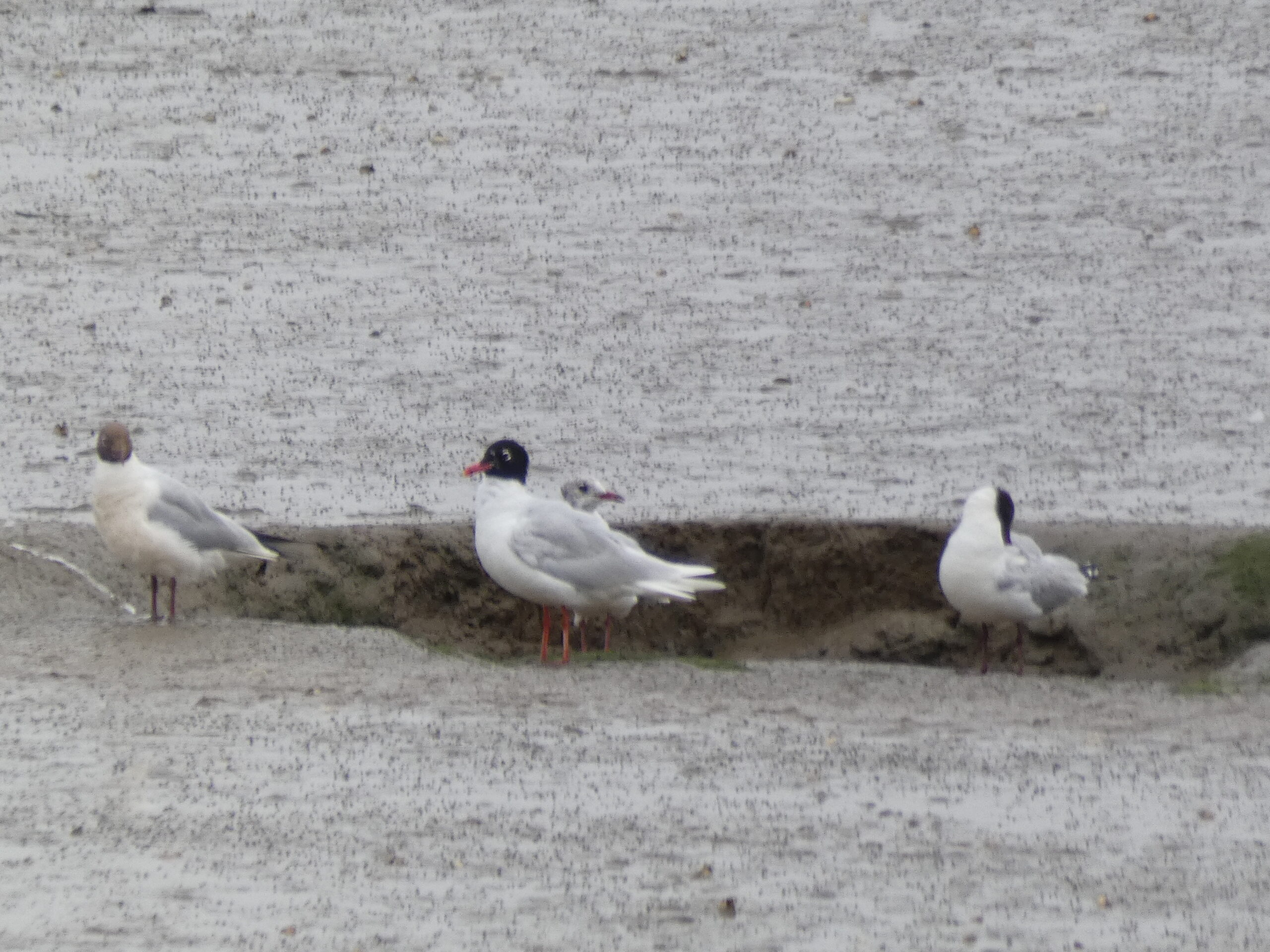
Mediterranean Gull in the middle showing a full black head, stockier build than the Black-Headed gull on the left
Finally, they make different calls. The sound of the Meds has been likened to a very high-pitched cat mewing.
Our project manager says they sound a bit like the late Frankie Howerd (if you remember that far back).
They are very different to the rowdy squawk of the black-headed gull which makes them easier to pick out from the crowd. You can listen to an audio clip of their call here Med Gull Audio Clip
Breeding:
The first Med gulls breeding in the UK was noted in Hampshire in 1968. They are on the international endangered list as an amber species, as they only raise one brood a year and the average clutch size is three. Both male and female parents share the incubation, which lasts between twenty-three and twenty-five days. The chick then develops quickly, and they have their juvenile feathers ready for flying about thirty-five to forty days after hatching.
The Joint Nature Conservancy Council (JNCC) points out that after the first successful Hampshire breeding pair, the next was at Dungeness, Kent. Then in 1983 a major colony was established in North Kent, which is now the biggest breeding colony in the UK. As usual, for ethical reasons, we won’t divulge the place here, as the birds need peace and quiet to breed. Do keep your eyes and ears open when walking on the coast, as that black-headed gull you gave a cursory glance to may just be something a little rarer.
Once fledged, the juveniles take two years to reach maturity and breed themselves. Living so closely with other related species of the gull family, they have been known to hybridise with black-headed gulls. Med gulls will also eat black-header chicks.
Threats to nesting on the coast:

A mixed roost of Black-headed and Mediterranean Gulls
Nesting Med gulls, and their neighbouring black-headed gulls, are very susceptible to nests being washed out by high tides, as they are just above the high-water line. The eggs are not protected by a nest structure as they are laid in a scrape on the ground.
Global warming and sea level rise may therefore have very serious implications for their reproduction in the future.
They also suffer from losing eggs due to wash generated by boats and kayaks manoeuvring too close to islands and marshy roosts. The waves they generate slap up against the low-lying nest colonies and wipe it out. Just one pass, too close, or too fast, can destroy an entire years breeding endeavour by the birds.
Allowing dogs to scare incubating birds from nests can also have a detrimental effect on egg and chick survival. So, if you find a nesting colony please give them a wide berth and if they appear anxious at your presence, back off.
Future research:
Surprisingly for a lot of UK seabird species, especially gulls, there is little or no data concerning the way the birds interact with the environment. Even now, after fifty-three years of this species breeding in the UK, we have minimal information concerning its life and threats to the species. We don’t know how it will react in relation to subtle climate changes or how it interacts with other plant and animal life within its adopted habitat. With this in mind, it would be a fascinating gull to undertake future research projects on.