
Here in North Kent we have the largest heronry in the UK. It can be found at the RSPB Northward Hill Reserve, a 52.5-hectare (132 acres) Site of Special Scientific Interest, on the Hoo Peninsula. At last count there were 150 pairs of grey herons breeding and they have, over the years, been joined by about 50 pairs of little egrets.
Herons and egrets are part of the Ardeidae family of birds. It’s a very successful family with 64 members across the world. A collection of herons is known as a siege.
The life of the grey heron:
The heron family can be found right across America, Europe and Russia, aways by water where it finds its prey. Different types include the purple, great blue, zig zag, dwarf, boat-billed, agami, Pacific reef, tri-coloured, striated, whistling, the list goes on.
 When sat hunched up, they can appear like a large messy furled umbrella, with grey shaggy feathers which look a bit unkempt. They have yellow eyes with a large black iris and a long, rather dangerous looking, yellow pointed beak. At almost a metre high they are large and have a wingspan of almost twice that. If you want to spot one go to the bend of a river, where the flow of water slows and is shallow, they stand there looking for fish. They are also common on marsh land, as they like frogs as well as fish. Often, as they stand so quietly, it is easy to be alarmed by them as they fly off with a loud croak when they spot you. As with all birds, if you spot them in good time do back off to avoid this happening.
 Grey herons lay three to four eggs in a stack of twigs and branches built in large trees. It’s generally too messy to be called a nest, more like a platform. They love creating communities and are site faithful, returning to the same nest created in earlier years. The antics of juvenile herons, who are learning to fly from their rickety nests is definitely something to witness. They are a quiet bird with no song, just grumping calls and a lot of bill clacking. Some live here all year round, some only visit in summer. We can have up to eleven thousand pairs in the country.
Little egrets:
Half the size of a grey heron, these are a lovely crisp white bird which, when walking, picks its way delicately along. They first arrived in the UK in Somerset, from the continent, in about 1986. Birders would drive for miles to see them. Now they are relatively common and stay all winter. They first bred in the UK in 1995. They are related to herons but form their own family called Egretta.
 In summer they have black legs and bright yellow feet. When feeding, they shuffle their feet through the mud in inlets. The action scares up fish and invertebrates, which they then peck at and pick up. Also, during the breeding season, they develop a wonderful fluffy range of feathers across their front and a feathery top knot like a wedding fascinator.
Their feathers were considered so beautiful that they were used in Edwardian times to trim ladies’ hats. This trade was in danger of making egrets an endangered species. So much so that in 1889 Emily Williamson campaigned to set up the Importation of Plumage (Prohibition) Act. Her success safeguarded many other bird species from exploitation in the wild as well. It led to the establishment of the RSPB
When is a little egret not a little egret? When it’s a great white egret, or a spoonbill, or a cattle egret!
Finally, if you are bored with egrets, they are still worth focusing on because that white bird with skinny legs may be something a little bit different. In the Medway area we also have great white egrets, cattle egrets and spoonbills.
 Great white egret:
Taller and very willowy in build, compared with a little egret, it has an enormously long neck, and a yellow beak, which turns black when breeding.
Its lower legs are black, with yellowish upper thighs.
They fly, like the little egret, with their heads pulled in and no neck visible.
Cattle egrets:
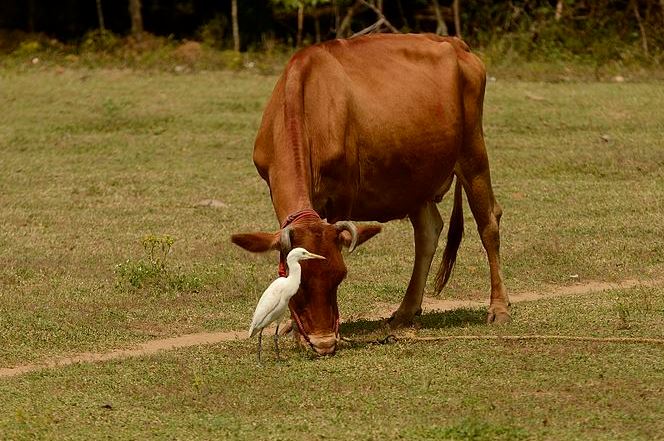
Credit: P Jeganathan Commons creative
Yes, cattle egrets are the ones on the David Attenborough documentaries. They are those white birds which perch on grazing water buffalo. They enjoy picking ticks and flies from the coats of cattle. They live, but don’t yet breed, in the UK. They can often be seen away from water following grazing animals. The hooves of the grazers kick up bugs and insects from the grass which are then snapped up. They also enjoy worms, frogs and mice
This species has yellow or grey legs and a yellow beak. It also has peachy coloured breast feathers, back feathers and cap in the spring and summer. They stand about half a meter high and fly with neck tucked in.
They have bred in the UK in the past but it’s not a regular occurrence… yet.
Spoonbills:
 Spoonbills are from a different family to herons and egret, the Threskiornithidae. They are noticeable when feeding as, unlike egret and herons which stab with their beaks, they sweep their beak from side to side. The tip is always kept in the water, slightly open to catch invertebrates. They are large at just under a meter tall, with black legs and a yellow tip to their beaks. Our birds tend to shuttle between the Isle of Sheppey and Rainham Marshes in Essex.
Really noticeable when flying overhead, they keep their necks extended. Their bill, with the rounded spoon at the end, gives a really distinctive silhouette.
We don’t have a breeding colony in our area, but Holkham in Norfolk does. They have one brood with three to four eggs laid.
Ranger Julie, when she first saw them, was told in all seriousness that a baby spoonbill is called a teaspoon… and a collection of spoonbills a bowl.
How to help:
If you think herons and egrets have to be your favourite bird, then there is a very easy way for you to help them. Every year, from late February, our friends at the BTO (British Trust for Ornithology) ask members of the public to become citizen scientists to help them count herons, egrets and cormorants. Being large, and very noticeable birds, this is a great way to begin your bird watching career, much easier than all those little brown birds hopping around on the floor and in trees. You really can’t miss them.
https://www.bto.org/our-science/projects/heronries-census
They ask that you register via their online link to survey and area with nests and count occupants, this can take from ten minutes to one hour of watching. Records have been kept since 1928, so you are definitely joining a worthwhile collection of scientific data. The data from 2019 indicates that grey herons managed to occupy 9,940 nests.