

In the next instalment of our Birding Basics series, Ranger Mel takes us on a journey through the wonderful world of waders and shares some handy hints and tips to help you identify the ones we see in north Kent. There is a short video clip to help you practice at the end and part 2 will follow this Friday.
Why do waders migrate to the UK ?
The UK mainland has a very convoluted coastline, and along with 1000’s of islands, offers a varied mix of coastal habitat which supports a huge variety of birdlife, stopping off to take advantage of our temperate climate. Temperate because, despite our northerly latitude, the Gulf Stream current (extended north-eastwards towards the UK by its much-underappreciated cousin, the North Atlantic Drift) brings us warmer and wetter conditions. This is paradise for many species of wader, having finished their spring/summer breeding high up in the Arctic tundra. As summer draws to a close and the tundra begins to freeze over they will begin to head southwards, taking advantage of our warmer weather and longer daylight hours, which means more time to feed.
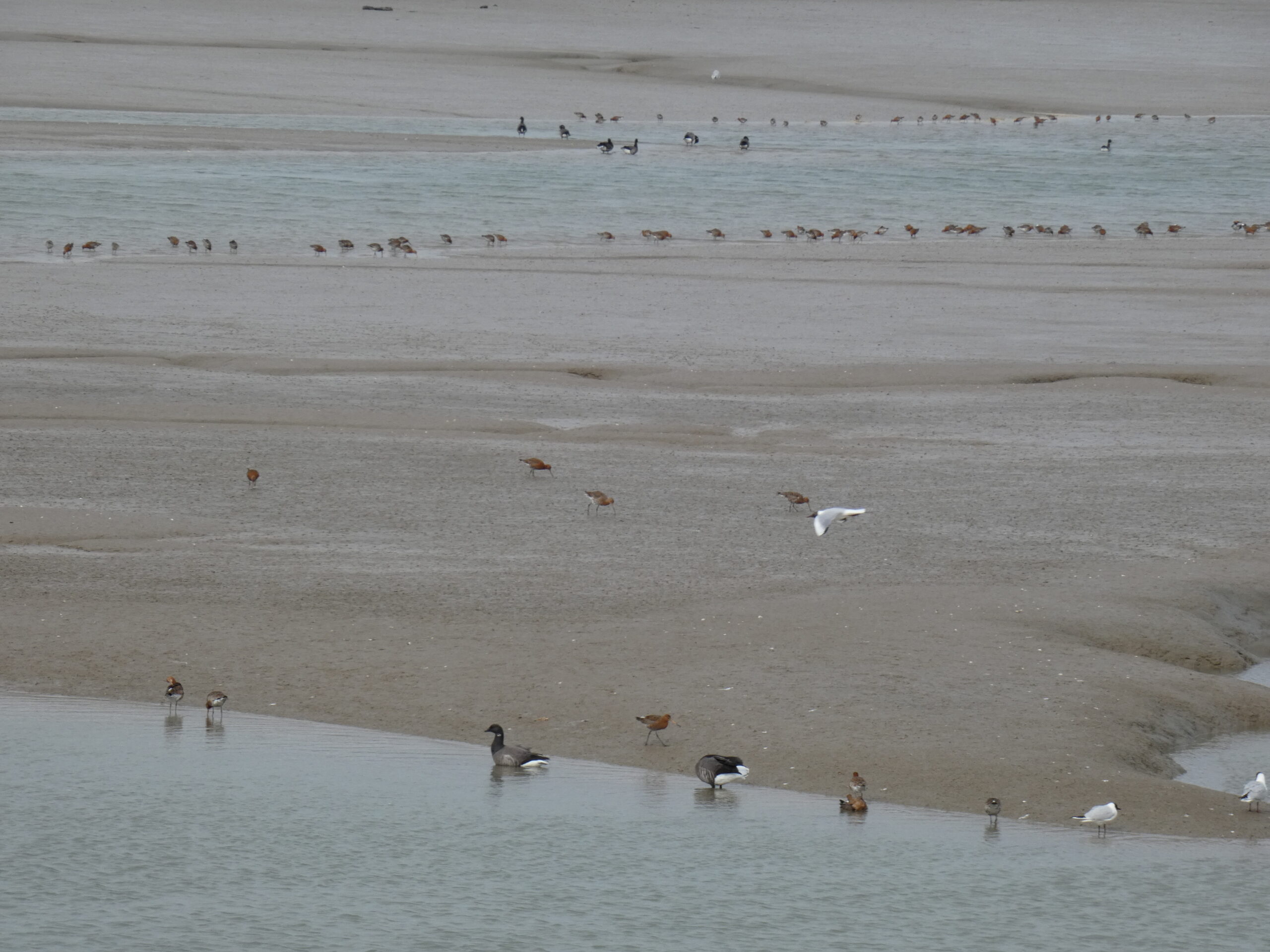 Mud = grub
Just under 50% of our coastline is classified as ‘estuarine’ habitat; shallow water environments where rivers meet the sea. Miles of coastline with tidal ebbs create vast areas of ‘available’ mud when the tide is out. This invertebrate and shellfish diner attracts 100’s of 1000’s of waders but you might also see some species feeding in coastal fields too, where they will forage for earthworms and insects, some turning to plant material and grains. In short, be prepared to see them at anywhere where there is water, marsh, sea or flooded land.
Do I really have to learn them all?
No is the short answer. Globally there are 213 species of wader and the RSPB states that around 77 of these have been recorded in the UK as migrants or breeders. Of these 77, about 40 of them are very rare or vagrants. These are the birds arriving accidently (and in a somewhat surprised state!) having been blown off course by severe weather on migration. Of the remaining, roughly 28 or so regularly occur on our Kentish marshes and mudflats.
213 down to 28. That’s better. You might think even 28 a daunting task to identify but, we can assure you, it is not half as difficult as it sounds if you learn a few basic observation skills… and if you’ve ever quietly said to yourself…”well they all look the same to me” then this is the article for you…
So, how do you know when you are looking at a wader? What features and behaviours do they have that are different to, say, garden birds or hawks or ducks?
Unique features of waders
Here’s a summary list to get you thinking. There are a few exceptions to these general rules, but we have to start somewhere…
- Long legs for wading, and therefore feeding, in shallow water and mud.
- Elongated and agile toes to help them balance in currents and shifting mud / spreading their weight to prevent sinking.
- Longish, thin bills for foraging (beak length and structure varies depending on food preferences and species).
- Usually associated with wetlands and coastal margins (also flooded fields and gravel pits)
- Usually ground nesting.
- Generally, don’t swim or paddle out of their depth – they don’t have webbed feet (exceptions, Avocets and Phalaropes).
- Young are able to fend for themselves pretty much from when they hatch.
- Often gregarious and noisy, roosting and flying in huge flocks.
- Pointed wings and streamlined bodies for long distance migration.
Most are global, long distance travellers and some hold quite unfathomable records for the longest non-stop flights. Tracking devices have monitored the Bar-tailed godwit flying continuously for 9 days, migrating from Alaska to New Zealand. Such a remarkable feat of stamina and navigation.
All waders walk – they do not hop like the Passerines (perching, songbirds). A long, fine bill should identify a bird as a wader, using sensory mechanisms in their bill to feel for food and utilizing their long legs to forage in the muddy shallows. A few species have shorter bills; the plovers, for example, which includes the Lapwing. These are visual feeders and use their large eyes to spot their prey on the mud surface. They have a distinctive way of standing still and watching, running a few paces, picking off the surface, standing still again. Turnstones also have short, sturdy bills which they use to turn over pebbles and seaweed, revealing a plethora of hidden invertebrates and shrimps. These feeding strategies are unique to these birds and so very useful as a behavioural identifier.
You will probably have come across Herons, Coots and Moorhens – possibly Egrets, Spoonbills, Cranes, and Rails too feeding in the shallows. These birds might wade…but are not waders. Most are relatively easy to identify and distinctive enough to command positions in their own avian categories.
Some are easy…
Wader ID can sometimes be quite straightforward because a few species are unlike anything else and easy to identify, especially if you have access to a bird app or reference book. It’s handy when some fit nicely in the ‘once seen, never forgotten’ category. Avocets and Oystercatchers are good examples of this, although very different looking birds, they are the only waders with purely black and white monochrome plumages all year round. Their bills are also unique; the Avocet’s long, thin upturned bill which it uses as a sieve, sweeping it in an arc just below the surface – and the Oystercatcher’s stout, bright red-orange bill which it uses to prise open shellfish and dig for worms. Lapwings fit into the ‘very identifiable’ category too. It would be hard to confuse their upright stance, iridescent plumage, thin head crest and very ‘flappy’ way of flying with any other species.
-
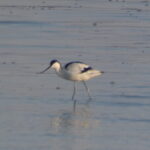
- Avocet
-
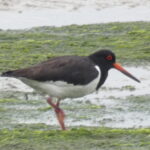
- Oystercatcher
-
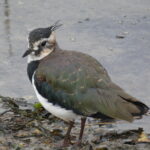
- Lapwing
And others are trickier…
For some species, like the ones shown above, plumage is a key identification feature because it won’t change, whatever the season. Many others though have different identifiable breeding and non-breeding plumages, as well as intermediate/transitional stages as they begin their annual moult. Then there are the juveniles who can look like adults in mid-moult. It can get complicated even to the trained eye and we should know… we regularly get it wrong! But that’s what it’s all about…having a go…and learning.
Curlews are our largest wader, they are tall and weigh up to 1kg. The Little Stint is one of the smallest waders in the world – 13cm long and half the weight of a golf ball. See if you can recognise some of the bird names in the size-groups below and if you have a bird book to hand, try and put a face to the name – or check out the individuals at our ‘MEET THE BIRDS’ section of our webpage.
| Large Waders | Medium-sized Waders | Small Waders |
| Curlew and Whimbrel | Redshank | Knot and Dunlin |
| Black-tailed Godwits | Greenshank | Ringed Plover |
| Bar-tailed Godwits | Spotted Redshank | Little Ringed Plover |
| Oystercatcher | Golden Plover and Grey Plover | Turnstone |
| Avocet | Lapwing | Sanderling |
| Ruff | Little Stint | |
| Green, Common, Curlew, Wood and Purple Sandpiper |
That’s a list of 25 but only about 12 of them (in blue) are seen as very common on our patch during winter.
How to really observe
If you read last week’s article on duck identification, the subject of ‘GISS’ was raised. This is a term used by birders and a technique employed to help with more confident identification. It stands for:
GI = General impression
S = Size
S = Shape
And my colleague suggests adding another S…for sound.
The idea is that every aspect of the bird is taken into account to help with the ID; not just its size, shape, length of bill and legs – but the way it moves, feeds, takes off, flies – what its call sounds like and the colour of its bare parts too if you can see them.
All of these features will help lead you down the ‘right’ road if you can observe them properly. I guess by that we mean in a more scientific and comparative way. We would always recommend carrying a notebook and doing a quick cartoon sketch of the bird you a looking at. A cartoon because it encourages you to exaggerate the key features and also the process of putting pen to paper helps use the brain in a more productive way…It really makes you take notice.
Using reference species
One of the best ways to start the identification process is to compare the bird you’re seeing to an easier-to-recognise ‘reference’ species. Since waders come in a variety of sizes we could probably do with selecting 3 species for reference (one from each size group) against which we can compare all others. The British Trust for Ornithology suggest using the Dunlin (small), the Redshank (medium) and the Curlew (large) – so we’ll go with those three species here.
-
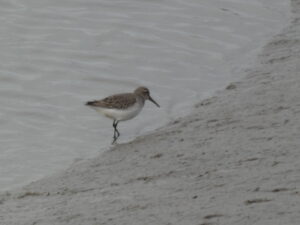
- Dunlin
-
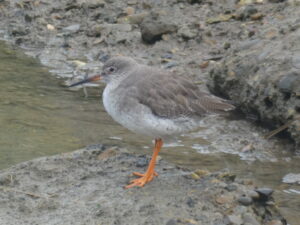
- Redshank
-
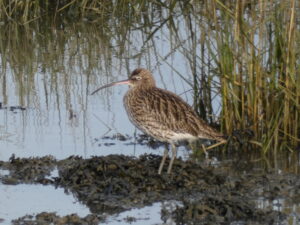
- Curlew
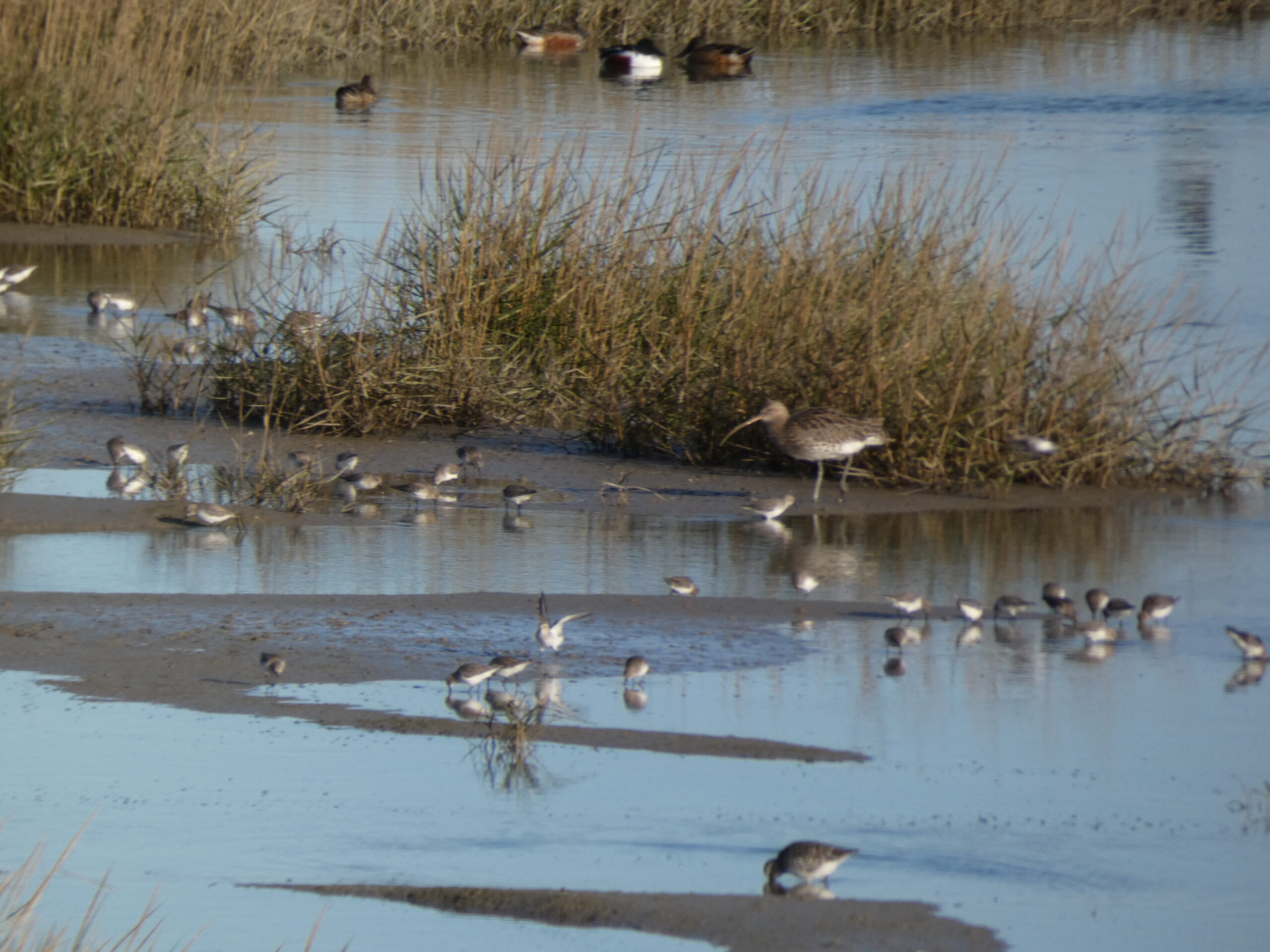
The picture above gives a better idea of scale, you can see the Curlew is much larger with a downward curved beak. The dunlin are much smaller. You have a good chance of encountering these 3 suspects because they can be seen all over the UK, in uplands and in coastal regions, at different times of the year. It’s a good starting point to get to know these three as well as you can – and by practicing your observational skills with them – you can then apply those same skills to any other bird you might see.
Let’s look in more detail at our reference species. Remember, we are first looking at size and structure – that’s body shape, bill size and leg length – and colour of these bare parts if you can see it. Plumage can be used as a confirming identifier too but we will mainly look at their winter/non-breeding livery since that is when they will be seen in the greatest numbers.
If we were to see them in silhouette or with the Sun behind them, they might be described as follows:
- A dumpy, compact body with a shortish neck. Short tail and wings (the wing feathers don’t extend beyond the tail). Slightly downcurved (decurved) bill with a stout base. If we compare the bill length to the size of the bird itself, we could say it was relatively long.
That’s the DUNLIN
- Tallish bird with a slender body, longish neck and long legs. Another way to describe bill length is to imagine its length in comparison to the head…do this by holding your finger and thumb out to ‘measure’ the bill and then move your finger/thumb to the head. You can then estimate the relative bill length in comparison to the bird’s head. You can do this in the field if the bird is still or just do it by eye. For example, this bird’s bill fits ‘into’ its head just once.
That’s the REDSHANK
- A rounded body with a very, very long, steadily decurved bill. Not at all slim or dumpy as the other two have been described.
That’s the CURLEW
What we’ve just done is describe their STRUCTURES because if they are on their own you won’t be able to judge their size. If you did see them together you would be able to tell that these 3 species are small, medium and large, respectively.
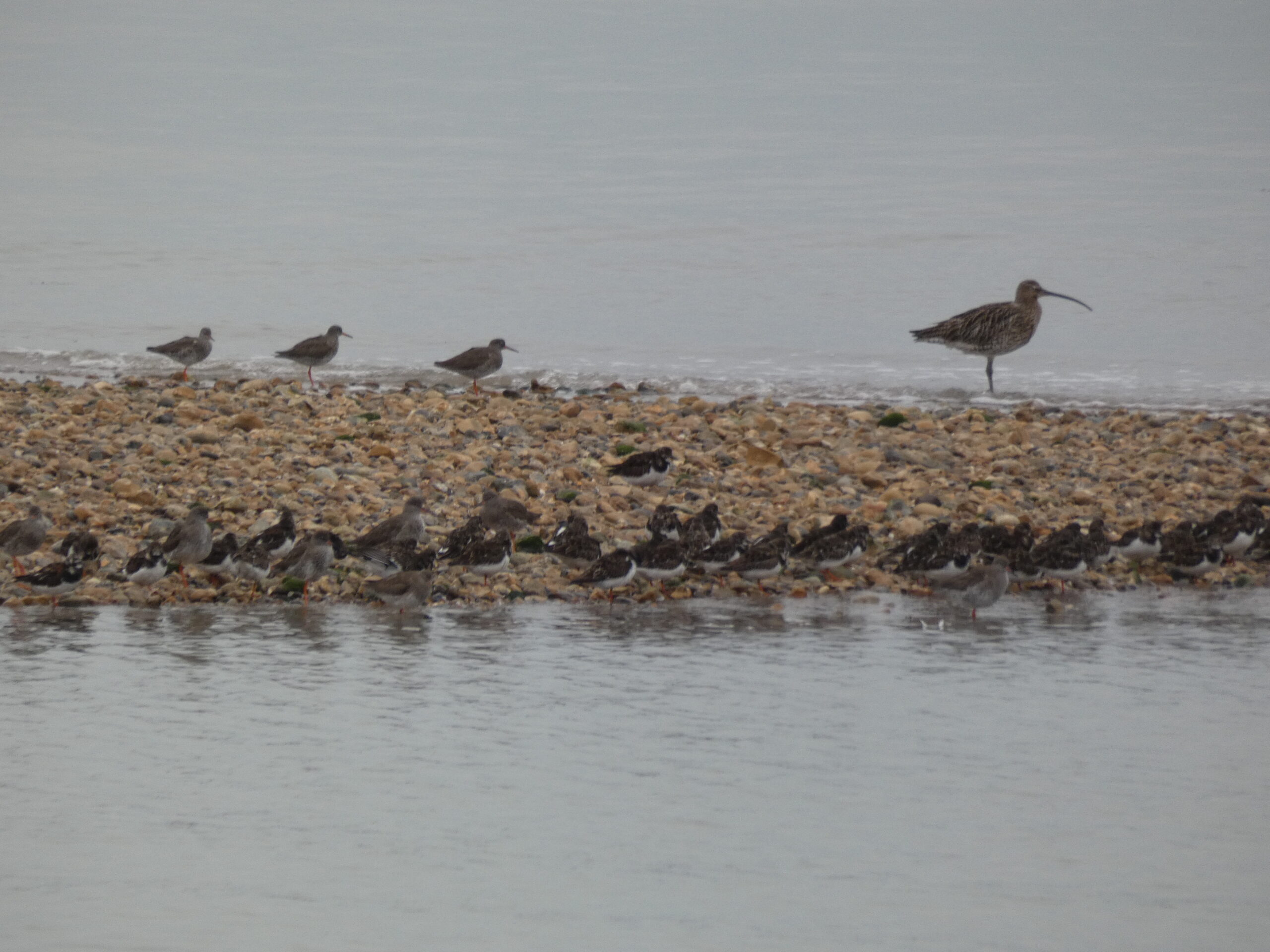
In the picture above, you can see 3 Redshank and a Curlew at the back with more Redshanks mixed with another small wader, the Turnstone, in the front. If you can get a closer view in good light conditions you might be able to see other identifying features such as the colour of the bill and legs (remember though legs can be muddied) and also plumage features, many of which will be particular to that bird.
Part 2 on Friday will look at these in more detail and also talk about the species which our 3 reference birds can often get confused with…
Until then, if you want to have a little practice why not watch the short video below which was filmed on the Medway Estuary to see how many waders you can identify without having to go outside in the cold, and you have the added benefit of being able to pause and zoom in! There are a few ducks in there too so check out the guides we posted last week to help you. Happy Birding.