

Once some individuals have mastered the art of birding with binoculars, sometimes a little frustration can start to creep in: the desire for more magnification! Telescopes (or spotting scopes as birders call them) can be the solution and if you have ever been next to someone using one, and they offer you a peek through their lens, everything becomes crystal clear – literally!
Scopes can magnify your subject up to 60x and this closer inspection of plumage, structure and behaviour can make for more confident identifications. At the very least, it will give you an overall better view on your day out in the field.
Both binoculars and scopes have their pros and cons and birders will usually carry both, switching between the two for different circumstances. A scope is no substitute for binoculars: more of an enhancement or add-on which will make birdwatching even more enjoyable. Reminiscent of when I first looked down into the lens of a microscope at college, the magnified world is an experience to behold.
Binoculars are mostly used to scan wide areas to spot birds or follow fast moving birds and those in flight. Scopes come into their own when the birds are at some distance such as on the coast, on lakes or open fields. At distance they will appear more stationary. There is a knack to watching birds in flight with a scope but for speed of movement and a good field of view, binoculars are usually the lens of choice. Scopes are of limited use in wooded areas or when birds are at close range in bushes or scrub…unless you are looking at a roosting perched owl!
So, how to choose? Here Ranger Mel looks at some factors you may want to consider:
Size
The main variable affecting size is the diameter of the objective lens: the large lens at the business-end. The most commonly used diameter is 60 to 80mm and the former will suit most people’s needs. 50mm mini scopes are available and intrepid travellers make good use of this size. Lenses larger than 80mm will gather more light with the downside being weight, they are not particularly portable for long walks. We have all experienced carrying a weight for a short amount of time thinking “this is fine”…..and then as time goes by….regret!. However, they come into their own in low light conditions and from fixed positions such as in a hide.
Magnification
Magnification can range from 15x up to 60x and most scopes have interchangeable eyepieces (fixed or zoom) which can be purchased separately so you can carry more than one for different light conditions and situations.
Zoom eyepieces do offer more flexibility but will result in a narrower field of view (and be more expensive). Their adjustable settings will give a magnification of, for example, 20x to 60x or 15x to 40x – but higher power means less light passing into the eye.
A wide angled fixed 20x to 30x should suffice and, especially in poor light conditions, will probably give you a better image than a 40x magnification. Remember also, as with binoculars, higher magnification will also amplify unhelpful effects such as heat haze, shimmer and shake – and don’t forget the narrower field of view.
Generally speaking, high magnification lenses are best used in bright conditions and to view more stationary subjects.
Top tip: retractable eye cups will be necessary if you wear glasses. Check your scope has these
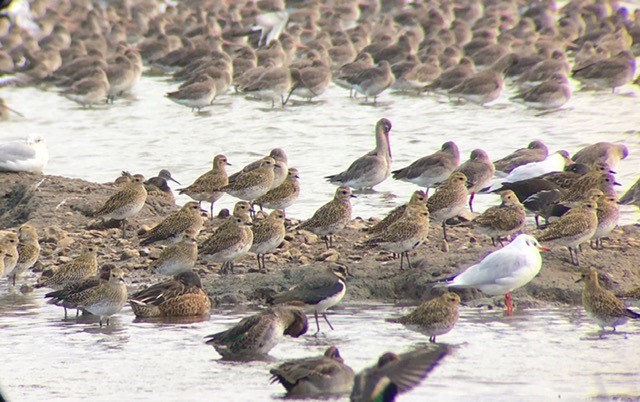
A picture taken through the scope with a mobile phone
Straight or angled
Most scopes come in straight or angled form, each with their own advantages. Straight versions are easier to use in hides when you are sitting down, and to scan and locate birds. They are less useful when you want to lock onto soaring birds or birds high up in trees or on cliff tops. An angled eyepiece at 45 degrees will suit taller users and can be more comfortable to use for prolonged periods of time (less neck strain). Also watch birds at height will be easier. Tripods can be set up at a lower position with angled scopes which will help with stability and allow for less shake.
Top tip: learn to use with both eyes to lessen eyestrain and discomfort from prolonged squinting
Waterproofing and cases
‘Stay-on cases’ are a must and worth the extra you will pay to purchase them separately. Having shelled out on the scope itself you will want to protect it from knocks and accidental damage, especially when in transit and any type of cover will protect it from light rain.
Again, paying extra for a waterproof model will protect your investment and give you more time in the field when the bad weather descends! More expensive models contain nitrogen which serves to keep out moisture and dust. Often birders who haven’t purchased this added extra on their first scope, will probably consider it for their second one! At lower cost to yourself though, ensure your cover at the very least has a weather-hood that will extend over the lens when the weather turns.
How much should I pay
A good quality 60mm scope with a fixed eyepiece could be as low as £250. Upwards of £250 to around £500 will begin to get you a larger objective lens. Top quality equipment will cost in excess of £500 and some top-of-the-range scopes may also have low-dispersion (ED) or fluorite glass. This is an image-enhancing lens coating which will lessen or eliminate colour fringing (when the subject is outlined with a coloured hue or aura) and produce a sharper, brighter image.

The scope in action – note picture taken pre-Covid restrictions
Not forgetting tripods
Your scope is a precision instrument and will need a reasonable tripod to minimise shake/vibration in windy conditions and give it a good solid footing should it get knocked during use.
It should extend enough so you don’t have to stoop to look through the eyepiece but equally you may wish to share your view with other people of differing heights. When setting up on uneven surfaces it can take some amount of adjustment to the individual legs to get it level and stable. This is made a whole lot easier if the leg-lock levers are within easy reach at the top of the legs. Speed is sometimes of the essence before that rare birds makes it getaway!
Ideally the tripod will be matched with the scope it will be supporting. It needs to be sturdy and heavy enough to support the weight so that the scope, once attached, doesn’t feel too top heavy. Overall balance and centre of gravity is essential if over-toppling is to be avoided, especially when on uneven ground.
A sturdy tripod will help dampen down vibration effects from wind when you are in exposed areas. Remember also that there is less ‘weather’ at ground level so there nothing to stop you (apart from crunchy knees!) from kneeling down or sitting on a low rock and setting the tripod up at low level to get out of the wind. Some versions allow for very wide leg extension, bringing the scope lower to the ground.
The tripod head itself is usually detachable and can be bought separately. Check that yours is suitable for birdwatching as some will only be suitable as a camera/video mount. ‘Fluid heads’ are popular amongst birders because they are easy to use and have a smooth action. Ensure you also check the load bearing capacity in relation to the scope you intend to use. This information will be in the sales information and if in doubt, ask.
It can be useful if the attachment plate has a quick release function and will speed things up if you are swapping in and out of using both camera and telescope.
I usually carry my telescope attached to the tripod and over my shoulder, with the legs partially extended. I’ve also fitted some foam heating pipe-insulation tubes to make this more comfortable on the shoulder. Fully extended legs, whilst traversing rough terrain may not be a good or a safe idea. Some people carry tripods on their back with a strap or with an integrated tripod rucksack. The choice is personal and depends on what environment you will be using it in.
Our main recommendation is, as always, try kit out if you can before you buy. The RSPB offer demonstration events where you can experience different models and get expert advice. Currently many of the planned events up to January at least have been postponed but keep your eye on their web pages as others will be added as and when Covid restrictions relax.