

Welcome to part 3 of our Duck ID blogs. In this final part, Ranger Julie explains how you can use sound to identify different ducks out on the north Kent coast. We’ve included some video clips to help so you don’t even need to leave the house to practice!
Quacks Like a Duck, Must be a Duck: ID part 3
If you have read the earlier parts of duck ID. then you know that not all ducks produce a raucous, far travelling, long running quack. It’s only the mallard which does that. Others whistle, growl, hiss or are so quiet it’s impossible to hear them if you are observing from a distance.
Why do birds make a noise?
They have two different vocalisations: Songs and calls.
Calls are set patterns of sounds which convey something, such as an alarm. These are hard wired into the pays and are the same for each member. Songs are a variety of invented embroideries of their existing repertoire of sounds. They can be specific to an individual rather than universal to a species.
Ducks just call or are mute. They are most vocal when they are courting, defending territory or are alarmed. If they are disturbed from their roost or feeding area, they take off first, calling as they fly to safety.
 Wigeon:
Male wigeon have a whistley ‘weeeooh, weeooh’ and a ‘whip, whip’ noise whereas the females growl. Their whistling call is my favourite and creates a lovely audio backdrop to a walk. The little wiggle bob, which the males make, is very entertaining.
https://www.youtube.com/watch?v=MB3aZAoiPIg
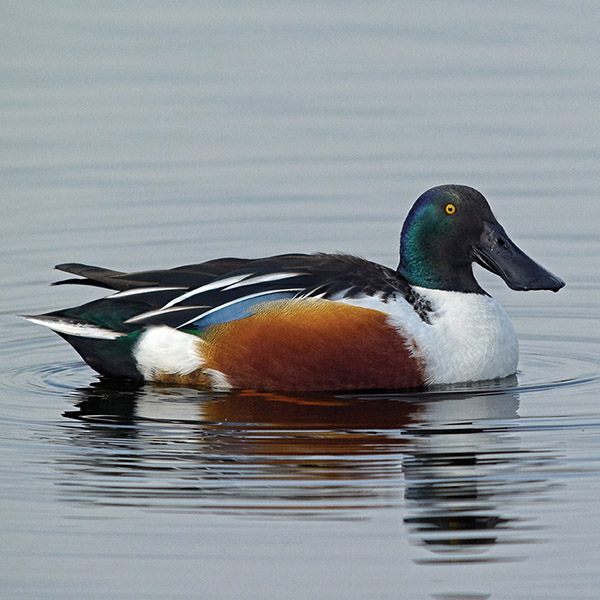
Shoveler:
A very quiet duck. Males make a ‘che chip chip’ noise. The females almost quack, but not quite. It’s weedy and more of a ‘Qwee, qwee, qwee’, sneezy sort of noise.
https://www.youtube.com/watch?v=ub7selHmEU0
On this clip the watery sounds are their beaks being used to sieve food from the water. There is also the noise of wingbeats as they take off. So, don’t forget sounds from birds don’t have to be calls. Some wing beats are very noticeable. Below is a link to the sound of swan wings, they produce the most noticeable waterfowl flight noises. Once you can identify them, move on to listen for the softer, less noticeable, flying sounds which the ducks you are observing make. Sometimes, in a busy bird environment, it’s helpful to tune out noise which you recognise, then you can concentrate on identifying the more elusive ones.
https://www.youtube.com/watch?v=RodM0lEZy98
 Shelduck:
Most of the time Shelduck growl, very very quietly.
In this clip, the first male appears to be trying to court a female with a different noise. Ignore the louder bird noises in the background. It’s the little ‘zup zup zup zup’ you are listening for. Watch for when the beak opens slightly. The movement of the neck is another GISSS feature visible over a long distance.
Females make an ‘arakkk arrrraaaakkk’ noise.
https://www.youtube.com/watch?v=A0WkT8ltZMo
(The clip is mute to begin with, so keep watching and the sound will come on.)
 Gadwall:
These make a ‘wek wek’ sound. It’s almost a quack, but with nowhere near the volume or force of the mallard. Females make the same pattern of calls, but in a higher key it becomes more of a ‘ek ek ek ek ek!’
https://www.youtube.com/watch?v=GBaEHtcyDpQ
This clip was filmed at Sandwich Bay, part of the Bird Wise East Kent patch.
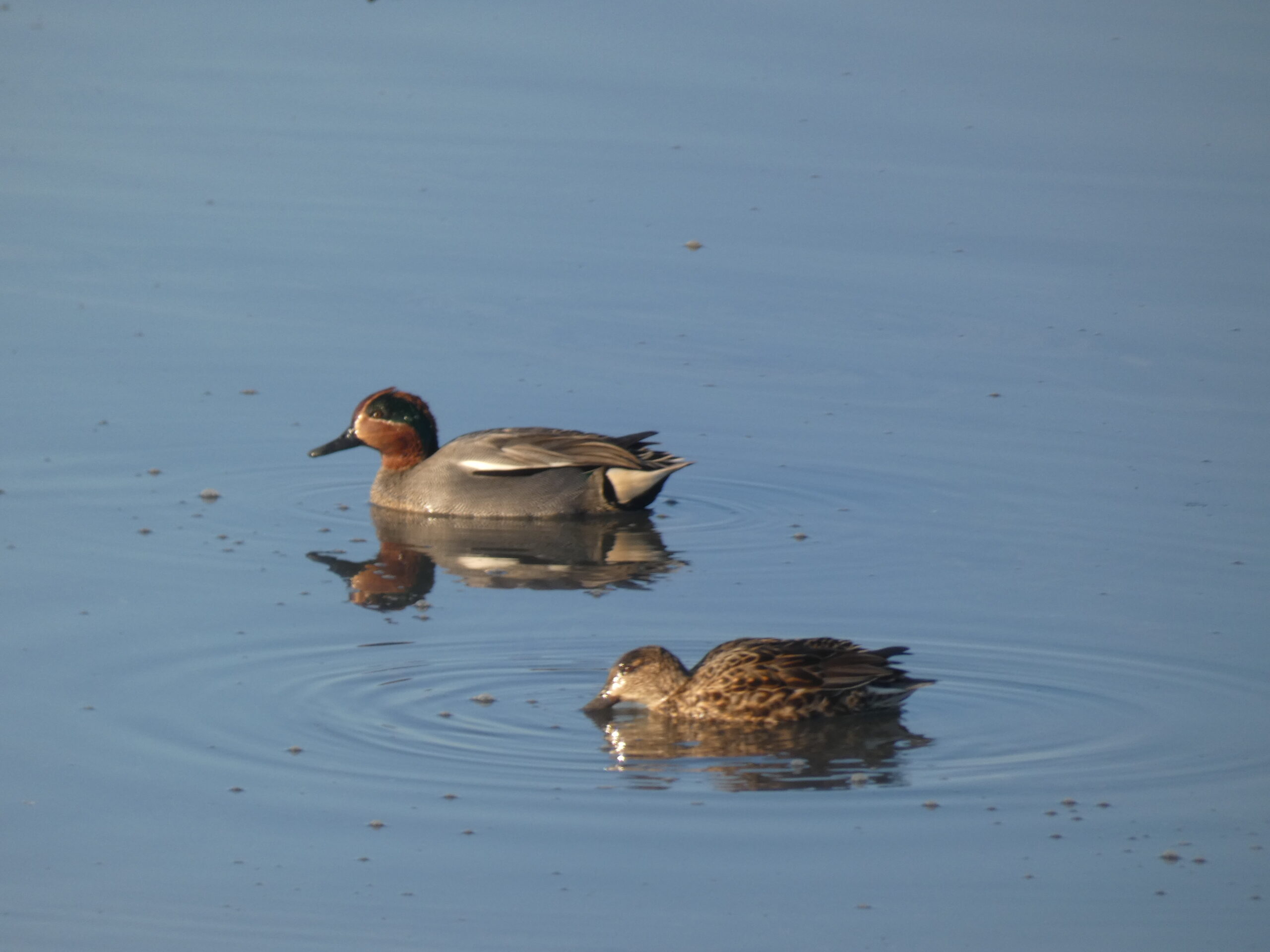 Teal:
Male teal produce a very high-pitched ‘Puwep pup pwep pup pwep pwep pwep’ It can sound quite warbly. Whilst females make a ‘wak wak’ sound. Again high-pitched, not quite a quack, but definitely a duck sound.
https://www.youtube.com/watch?v=9YB18ldkTY4
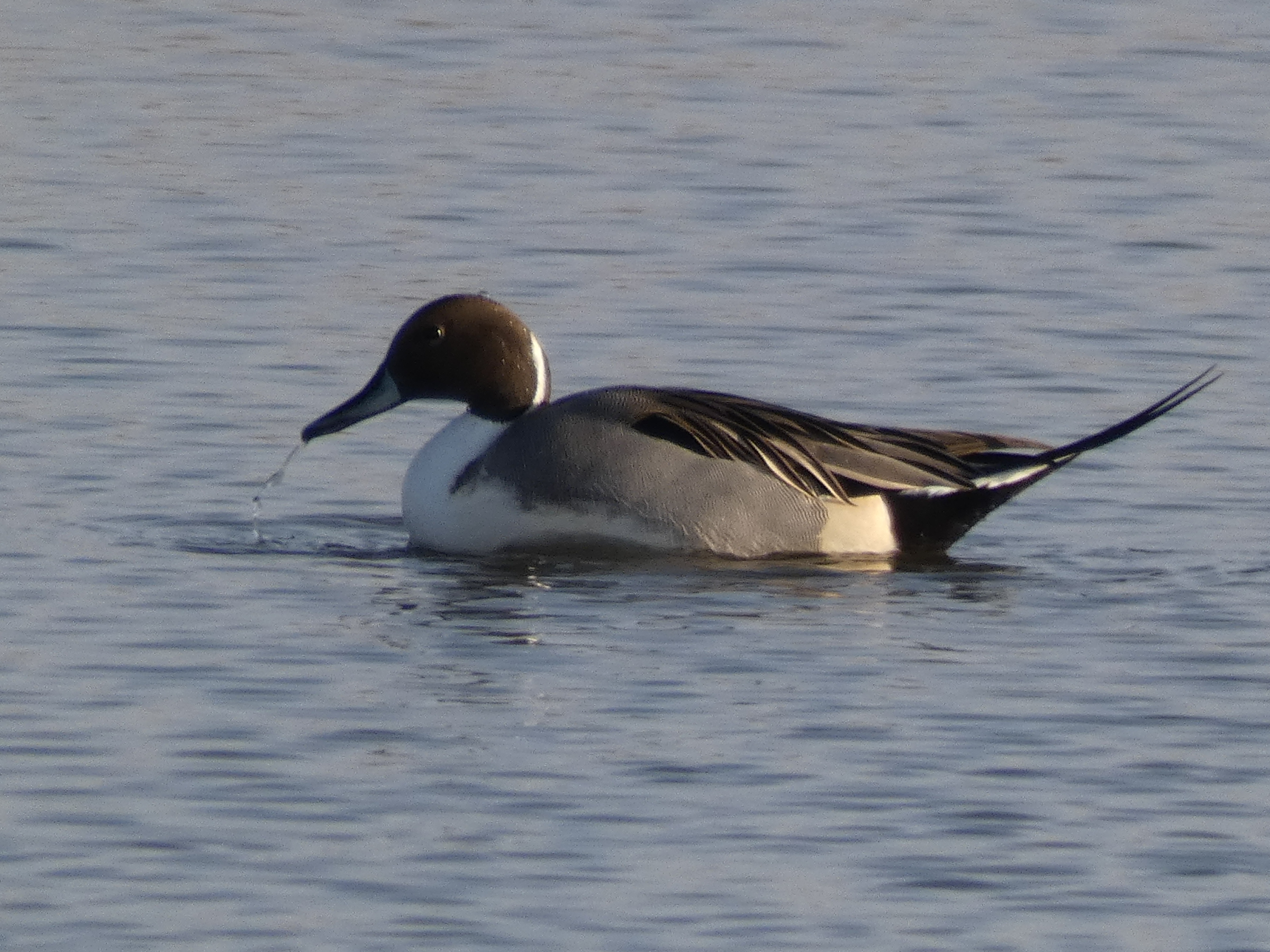 Pintail
When we see the pintail during the winter in UK waters, it is generally mute. However, in summer, when it breeds in Iceland, Sweden, Finland, the Baltic States and northwest Russia, it is a little nosier.
It has a very faint ‘purrup, purrip, purrup, prip’ which is sometimes accompanied by a squeaky whistle. In this clip, the males rear up and stretch their necks then wiggle their tails. A drab female in amongst them can also be heard to make a much deeper ‘pirrup’ noise. She’s also not very interested in the males, despite them trying to impress her. Poor pintails.
https://www.youtube.com/watch?v=gKU42FkOd2o
Eider Ducks:
Not a duck you are necessarily going to come across in our area. Although occasionally we do get the odd stray on our coasts. However, they have a fantastic call! I couldn’t resit adding them. Go to Seahouses Harbour, Northumbria, to catch a boat to the Farne Islands and they will waddle up to you and steal your chips. They are guaranteed to make you laugh or at the very least smile.
https://www.youtube.com/watch?v=END6WV9Ya7Q
Yes, this is a real recording. The males ‘Wooh’, the females make a growly ‘hu gh, hu gh, hu gh’.
And here’s what they look like.
https://www.youtube.com/watch?v=wwD9-4vN8rw
After finishing writing this piece, I went online to check the Kent Birding Facebook page. There was a beautiful image of a male Eider swimming in the Swale which had been taken the previous day! So, like I said, always keep your eyes open and be receptive of the possibility of seeing new species.
How to develop your listening skills:
See my earlier Bird Wise news post about songs and calls, it has some good guidance for how to start. I’ve reproduced a couple of links from that page below so you can revise your calls:
https://www.rspb.org.uk/birds-and-wildlife/bird-songs/what-bird-is-that/
RSPB Handbook of British Birds, eBook edited by Tim Cleeves, which has individual bird calls and songs for each species.
If you get into memorising songs and calls, use this site. They would also be delighted if you wanted to post your own recordings or photos. It’s a great citizen science site with very high standards.
Often it can be overwhelming when out on the shore, as the birds are not thoughtful enough to take it in turn to call or sing. As a result, you get overlapping calls, which can be difficult to sort one from the other. One resource which has really helped me with this is the material recorded by Geoff Sample.
Here’s a bit about Geoff.
https://www.geoffsample.com/wildsong.html
He records whole environment sound scapes. This makes you feel you are in the habitat and you can hear the key species interacting. Look for the Collins Field Guides, which contain his CDs. Titles include Bird Songs and Calls (my favourite), Wildlife Sounds, Garden Birds Songs and Calls, Warbler Songs and Calls. They are so lovely to listen to I fall asleep after a couple of tracks on the first CD! Each environment is carefully introduced at the beginning of the recording and birds are announced as they call or burst into song.
Being ethical:
Finally, to be an ethical birder do not use the calls on loudspeaker when near birds to lure them towards you. Hearing another bird may make them think a rival is invading their territory, this wastes the bird’s energy and results in unnecessary anxiety for them. Anything which disturbs birds is bad.
If you need to listen to a recording whilst on site, use headphones.
Next week: Ranger Mel takes a look at the wonderful world of Waders.