

The current lockdown restrictions might mean we can’t get out very much to watch birds, but that doesn’t mean we can’t brush up on some ID skills at home. This week we are bringing you three articles to help you ID ducks from the comfort and safety of your own home. In part 1, Ranger Julie introduces us to some basics to get you on your way.
It’s fine pouring through bird ID books and trying to memorise all those images of ducks. However, when you are in the field, birds don’t sit still. They move, they are in different stages of moult or colouration. They swim, fly, preen and stand in a completely different position to the pictures you have in front of you. How on earth can you begin to identify them?
The answer is GISS – Never heard of it? Well, this is a really important technique to move your bird ID skills up to the next level. It’s the overall impression which a bird conveys. Not just the colour of the wing feathers, the shape of the beak or body, but the way it walks, flies, calls, dives, perches. Everything combined in a moving image, which means that the particular bird in front of you can’t be anything else. I know this can sound overwhelming, but let’s break it down into smaller manageable elements, which you can master one by one…
GI = General impression. The whole picture.
S = Size
S = Shape
I would also add another ‘S’ for sound. So GISSS.
Where to start: General Impression
For each species of bird, you need an easily identifiable default member of that species. One whose image you can call to mind. You can then use it as a comparison, to work out if any birds you can see on your birding trip may be related. Once you can guess what species a bird belongs to, it’s also easier to find them in a serious bird ID guide. You can look under the species’ classification.
So, let’s work out the GISSS for a species which all of you will be familiar with and be able to call to mind straight away…
Today it’s ducks…
Imagine you have been told to look for a duck. The basic generic image of a duck for people in the UK is the Mallard. Everyone has seen a Mallard.
So, you are looking for something with webbed feet which lives on or near water. It has a long scoopy beak rather than a pointy thin one. Swims well. Waddles when on land. Quacks.
That’s a pretty comprehensive description, before we have even got onto feather colour. So, already you have a generic idea what a member of the wider duck family will look like.
You could almost certainly recognise a strange duck, which whilst it was definitely a duck wasn’t a Mallard. That’s the key to beginning to ID your birds. You might not know what the name of the bird is you are looking at. However, if you can say with conviction it’s a duck, and it’s not a Mallard, then you can begin to identify this new species. You can also find it in the birding ID books to get its correct name.
Quacks like a duck must be a duck…
Believe it or not, Mallards are the only wild duck species which quack! So, hearing a quack from a duck which doesn’t look like a Mallard means that we have a domestic or hybrid duck which has Mallard in its genetic past. Mallards are the basis of all farm duck varieties. Yes, even the Jemima Puddle ducks, which have conspicuous white feathers.
Rather boringly many ducks are silent, or so quiet that it is impossible to hear them at a distance. Others growl, hiss and some whistle.
More about duck sounds in ‘Part 3’ due this Friday.
Feeling more confident?
So, we have a significant amount of information about the Mallard. We can now use it to identify that a new birds is part of the duck family.
Moving on to the next step… We need to refine this image of your Mallard, so that when you see a different duck, you realise straight away that it is not the same. We add the detail to help you tell them apart.
At this point you don’t need to know the name of the ‘not a Mallard duck’. Just being able to say you’re looking at a different species, can help start a conversation with a more experience birder, who can help you fill in the gaps.
Two by two, but make it easy for yourself…
 In this image we have two mallards, they are the same species look very different.
The front one is a male, the rear one a female. Don’t worry if you hadn’t realised this. As a beginner, at the moment, just concentrate on being able to identify male ducks. They are the colourful ones and their feathers give you a lot more pointers to potential ID. We can assume, to start with, that if a male duck and a brown duck are close together, sharing the same territory, that they may well be a pair of the same type. It’s lazy, but it saves driving yourself crazy.
Mallard GI = General impression
Look at this video to remind yourself of Mallard behaviour.
https://www.youtube.com/watch?v=mQJ6q1ZCzsg
The Mallard is, depending on the season, territorial. Here we see that as they chase each other, but it is a bit half hearted. The dominant ones speed up their swimming and dart a head at other ducks, trying to flush them to the edges of the group. So, it’s probably summer. Breeding and brood raising season over. Behaviour will change at other times of the year and aggression will rise if they are courting, breeding or raising ducklings.
The person filming is close by and none of the ducks are worried by this. So they are not a skittish, shy species.
We get ducks waddling along the bank. Watch how they do this.
However, none of them undertake classic feeding behaviour of Mallard. None of them in this clip up end to feed. This is known as dabbling. Spotting whether a duck does this is helpful in identification. We’ll discuss this later on.
Who else did you spot?
This is a large group of the same type of ducks. However, it is rare that you will only see one particular type of bird in a habitat. Extra point if you spot that there is a different duck sub species lurking in this clip. A white ‘domestic duck’ with an orange beak. It is a Mallard relative, although you wouldn’t guess it from the colouring. Looking at the colour, it could be an Aylesbury or a Call Duck. Look it up… There is also a cross bred duck which appears briefly on the bank. Beware, ducks interbreed and you can get some strange hybrid crosses. More about that in part two. There are also a couple of gulls in there…
Take a picture
Bird ID doesn’t have to be definitive, you can always revise it later. It’s also helpful if two of you are watching the same bird, as you might spot something your friend misses. Did it have yellow or orange legs? Any colouring on the beak? How far did the colour reach across the back? Did it have a long tail? Eye stripe? Repetitive movements? A specific way of feeding? If you are on your own why not take a picture? Doesn’t have to be David Attenborough quality. It’s just a note to compare with the bird books when you get home.
Dabbling or diving duck?
Ducks feed in two different ways. Dabbling or diving. Mallards are dabblers, they up end to stretch their necks out underwater and reach for greenery. Their bottoms remain in full view above the waterline. Divers, in contrast, go completely underwater to swim after prey or pick up weed.
Sorting out which is which, when you are observing a mixed group, can be a useful way of narrowing down what you are looking at.
Below is a link to some of those ducks which, in contrast to Mallard, dive.
https://www.bto.org/develop-your-skills/bird-identification/videos/identifying-diving-ducks
Diving ducks are much more ungainly on land than dabblers. That’s because their legs are attached to their bodies further back. This means that they can propel themselves along much more successfully underwater. However, when walking they look as if they may topple over forwards all the time, since they have much more body ahead of their legs than behind them.
The other end of the duck scale.
So, we’ve looked at Mallard. They come in at between 50 and 65 cm on average. Teal, in contrast, are only 36 cm. Tiny in comparison.
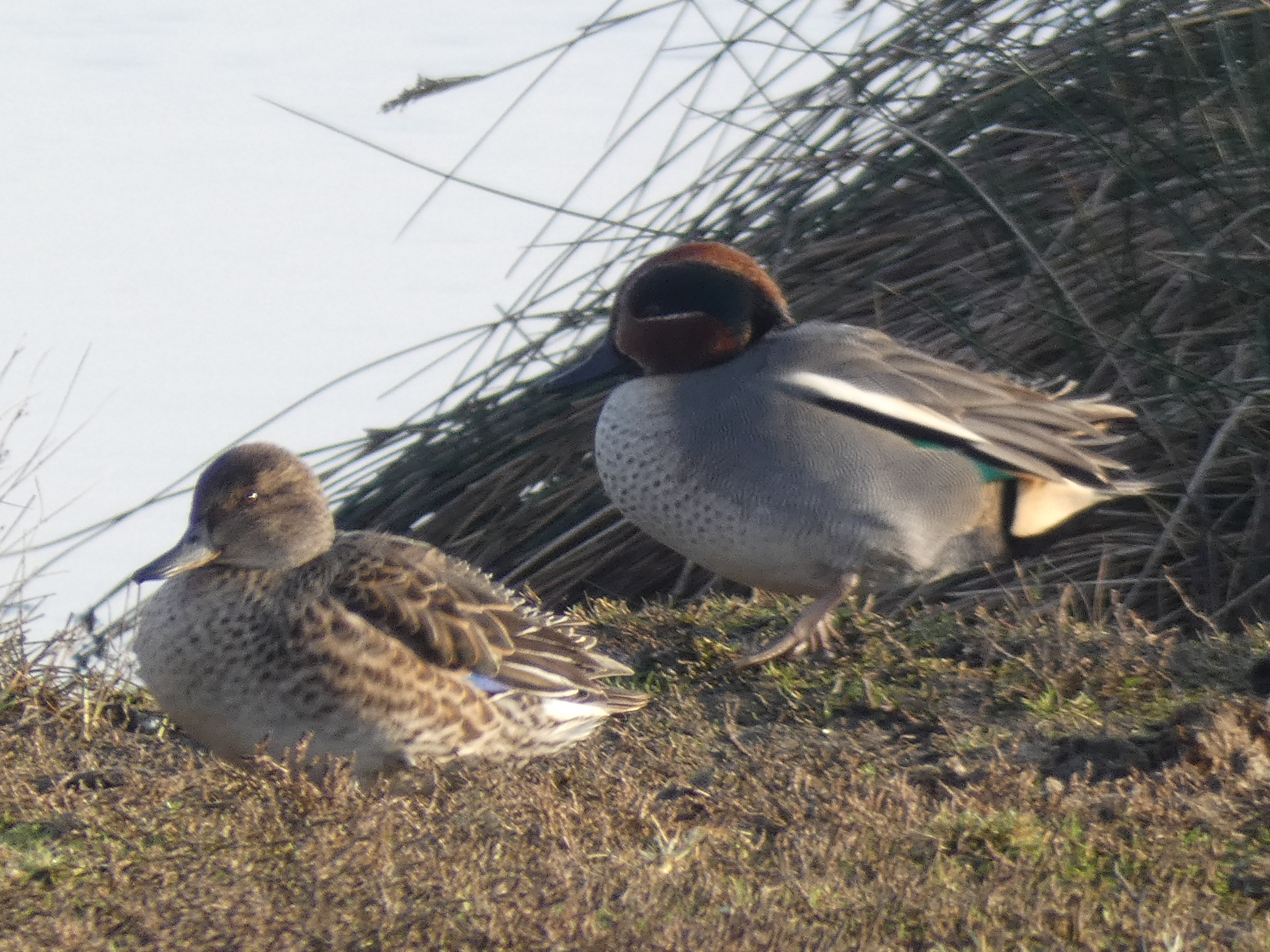 These measurements are taken from the tip of the bill to the tip of the tail. Other dimensions you may find listed in books are wingspan, which is wing tip to tip across the back of the body. Don’t forget, as ducks often sit with their necks shortened and bills tucked in their chest feathers when they are resting, they can appear a lot smaller.
Quick fix ID
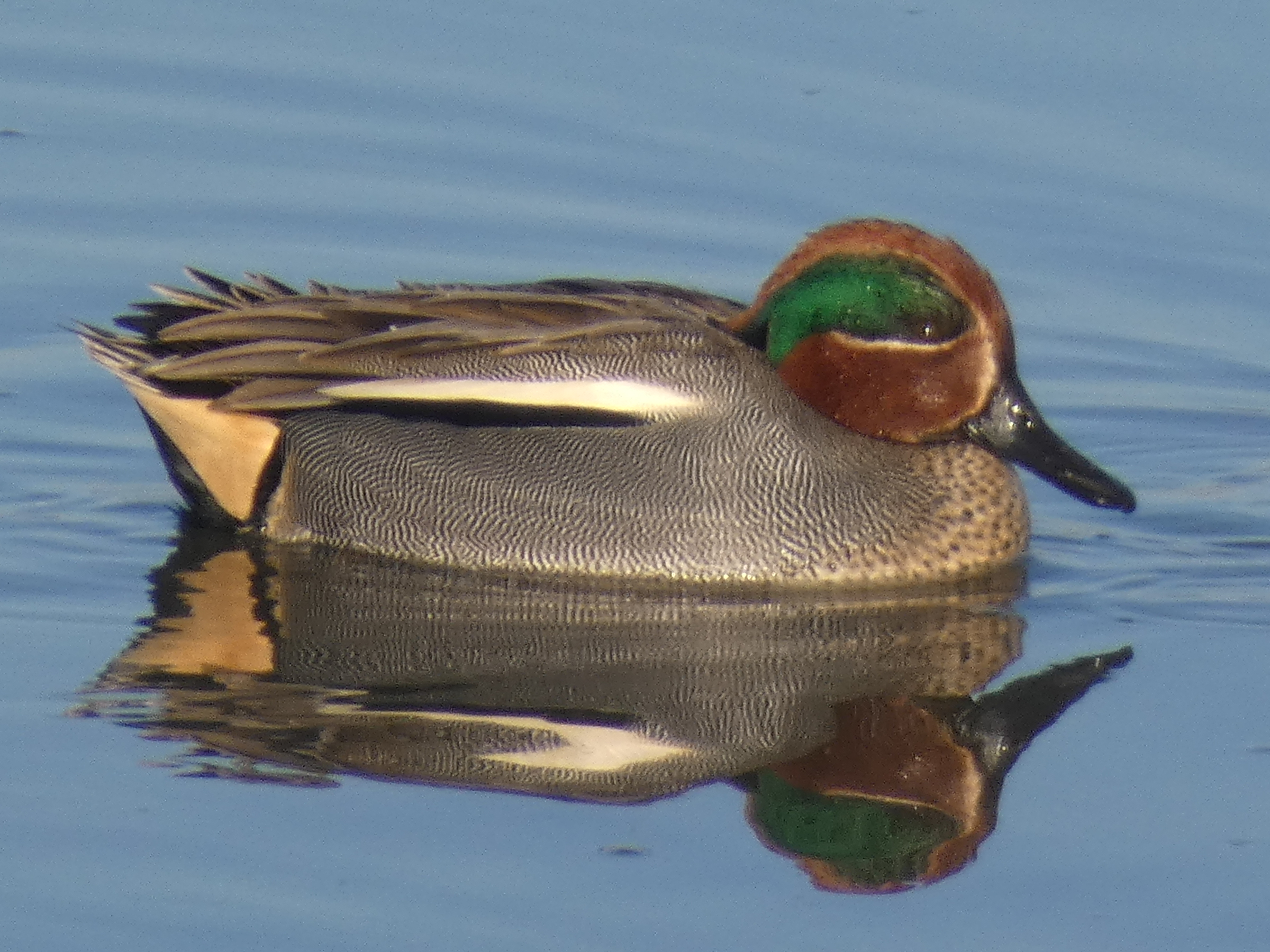
Create a memorable shorthand so you can remember the main feature a bird exhibits. For example, I always describe male Teal as the Elizabeth Taylor of the bird world. Think of her in Cleopatra, with that heavy eye makeup, then look at the Teal head markings…
What to do if a duck is too far away to see clearly?
Armed with a GISSS impression, visiting an area where ducks are a distance away from you, floating on water, shouldn’t be quite so much of a trial. Being less reliant on feather patterns means that spotting becomes more of a competition with yourself and your ‘I spy’ powers. You look, rather than trying to do a memory test inter-spaced with a lot of rifling through a book to find a picture. It helps narrow down the options in front of you. There are also a few more techniques you can work up in order to make spotting a little easier. We’ll be covering those in part 2 on Wednesday.
Finally…
When you want to learn about more than ducks, what species are the most useful to learn first?
Depending on which list you look at, there are about 321 different species of birds regularly seen in the UK. Below are nineteen different birds which I’ve selected. We see them all in Kent. If you can manage to memorise some basic characteristics of each of these, then you are well on your way to being a confident birder.
Species Ideal default species to ID in our area
Divers and Grebes Great Crested Grebe /little grebe
Gannets, Cormorant, Pelicans Cormorant
Bitterns and Herons Grey Heron / Little Egret
Wildfowl Mute Swan /Greylag Goose Mallard/Teal
Bird of Prey /Raptors Kestrel / Buzzard
Game birds Pheasant /Red-legged Partridge
Rails, Crakes, Coots Moorhen
Waders Redshank / Curlew
Skuas, gulls, terns Herring Gull / Black-headed Gull Common Tern
Size and Shape:
In the list above, the pairs of birds with a / between them gives you a large and a smaller bird from the same species to look at. Hopefully, other in between sizes of bird, from the same species, will then become easier to identify. They will have some of the characteristics of the ones you have memorised, even if you don’t know their names.
Don’t forget to come back on Wednesday for part 2 which will be looking at some more duck species.