

Ranger Julie is back with some more expert hints and tips to help you identify different duck species you might spot this time of year on our coasts, even when they are far from view or the weather is making it difficult to spot them clearly.
Duck ID: part 2
In part one we looked at the concept of GISSS. This is a great technique to help develop your bird ID skills.
 Our default species for the duck family was mallard and here to remind you we have our pair again. Male in the foreground, female behind. A perfect view. No trouble identifying these, but what if you can’t get close enough to pick out the subtle points?
Let’s face it, on a bad day, in this case when the sun is bouncing off the water, the image below could be the best view you get. The details of the image are lost, you only get large blocks of colour and you’re a little dazzled. You don’t need to panic though, just ask yourself what features are still registering?
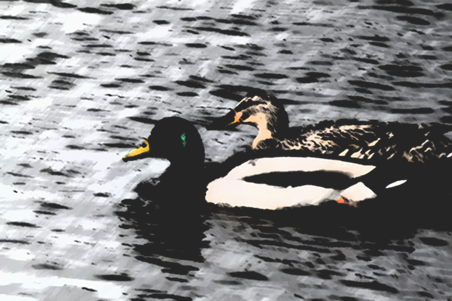 Well, you can still get that green head of the male. Even if you can’t register a colour, the difference between neck and body is very pronounced and helpful.
The orangey beak shows well. If you can’t get a colour, then try to get the silhouette. At the very least you can discount that as a Shoveler, with its distinctive wide flat beak.
In the male, the paler side panel of feathers with a darker wide flash is clear. That’s the brown edge to the folded wings.
Hopefully, in this case you wouldn’t be too bamboozled.
Teal:
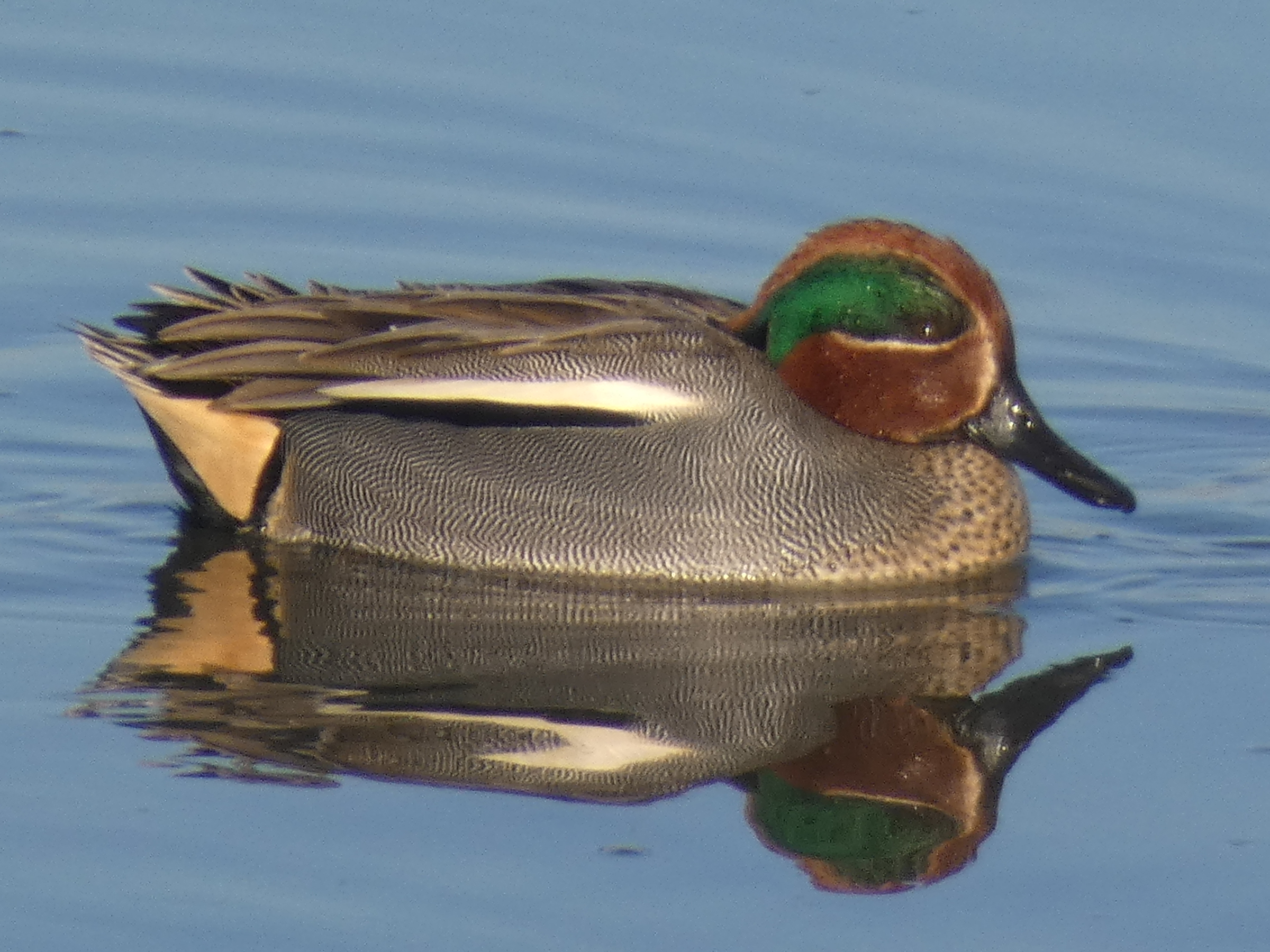
This is a male teal. It is the smallest of the UK ducks. They are dabblers (details about that in ‘Part one’).
It is a shy species and tends not to sit in the middle of deep open water. Preferring smaller ponds with vegetation on the banks.
https://www.youtube.com/watch?v=Up_Oq_graC0
This link will give you an idea of the behaviour you can see from teal. The film compares it with the garganey, which are much rarer, but hopefully you can see similarities and differences between the two birds.
 Here’s our teal through the scope. This time the sun isn’t ahead of us, bleaching everything out or turning it into a silhouette. It’s striking across the lens, so the colours are bright, but the edges of the different colours on the feathers are smudgey.
Again, don’t worry about what you can’t see. Ask yourself what you can see.
Green colour around the eye on the head. Pale breast, black stripes from wing feathers part way up the side. You might also get a hint of the yellow flash at the rear, on each side of the tail.
If the head hasn’t convinced you it’s a teal, keep watching the tail as the bird moves. The yellow flash may resolve itself a little better to confirm the sighting.
Shoveler:
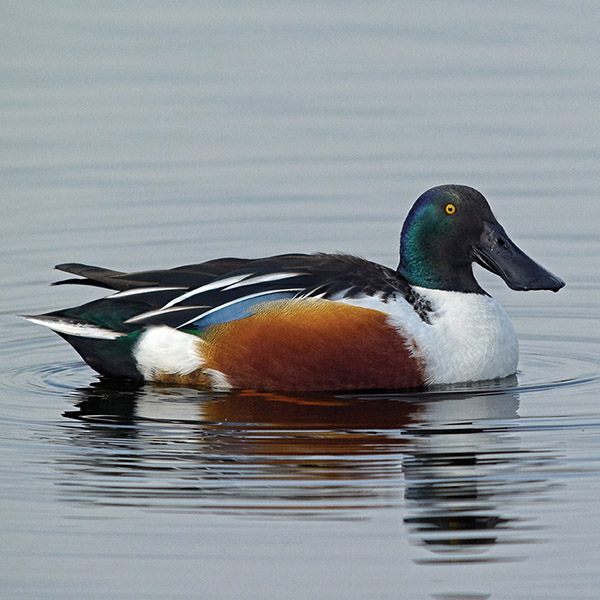 You can’t mistake a Shoveler. Just look at the silhouette of the beak…
I hate to tell you this, but over a long distance with problematic light, yes, you can mistake a Shoveler.
 On the right we have a Shelduck. With a clear view we have no problem telling them apart. The shelduck is a robust bird. This is a male with a conspicuous red ‘cob’ on the top of his beak. The female is identical except it has no cob. However, if the beak is difficult to see, the black and chestnut colouring can make you squint and wonder what it is.
From a distance, it isn’t so easy to tell them apart as the iridescent green on the shoveler neck looks blacker in a similar way to the neck of the shelduck. If the birds are seated and tucked up, as you will often see them if they aren’t feeding, the beaks will be out of sight on both birds. They hide them away under their chest feathers or a wing. So, that’s another major pointer gone.
In this case, all you are left with are the white panels to each side of the chestnut area. It’s this area you therefore need to focus on. In the shelduck the chestnut area is a band around the shoulders which runs across the chest. On the shoveler it’s a side panel. Get used to picking out the difference.
If they are moving GISSS can often help here. Shelducks love wide open mud and will walk a short distance from each other, moving their heads from side to side picking up food. They are very methodical.
Shovelers love to feed on water. They are terrific to watch if it is a day with a strong breeze on a scrape or inlet where the water is still. They will place the bottom part of their beak in the water and allow the wind to blow them around in a circle. They use the beak as a pivot and their rear feathers to catch the wind… It saves them paddling, other than to occasionally correct their trajectory. The beak scoops up food and they burn very few calories feeding this way. By the way, it’s impossible to take a decent photo of them when they are doing this, and they do make you feel dizzy!
Pintail:
These are my personal favourite! Similar in size to the mallard, but a totally different profile.
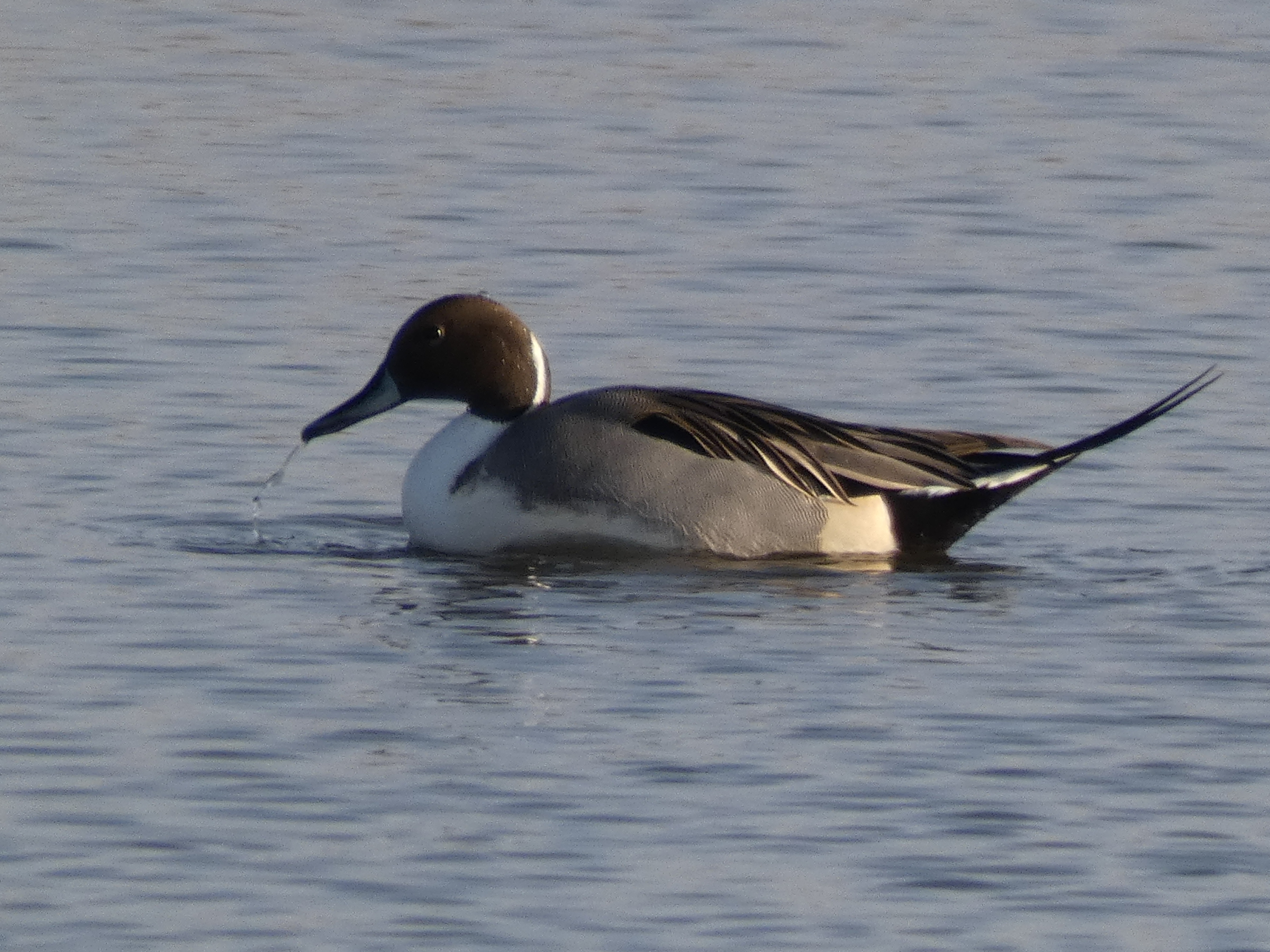 Slim with a black pointed tail. It can appear to have an extremely long neck when looking around or stretching. However, as above, when swimming it folds it’s neck in an elegant ‘S’ shape.
Very shaggy feathers on back. White breast. Grey mottled feathers along the side of the body. It’s one of the easiest long-distance birds to ID on the water. It’s the tail which is the give away. Even the female has a hint of a tail, which marks it out as different to other species.
The beak also provides a good marker and it appears longer and flatter than that of a mallard. It’s also black and gives a good outline. So, we should have little problem identifying a pintail and there is little chance to muddle the males up with anything else. Very straight forward.
Wigeon:

These winter visitors are very sociable and often seen in large mixed flocks and can be heard whistling to one another, we’ll cover their sounds in part 3 on Friday.
The golden forehead is a really easy marker for this bird, as is the chestnut head. However, be careful though as the Pochard also has a chestnut head so wait until they turn round and you can see the stripe.
Another pointer between the two is that Wigeon are dumpy and float with a rounded back. Pochard in contrast look to sit deeper on the water and have a flat back with less showing above the water. I’ll leave you to look up the Pochard so you can see the differences for yourself.
And now for one that looks like a duck but isnt……
The Brent Goose
I often get a lot of walkers, at the start of the winter, asking me about the big grey ducks which have turned up on the coast. Well, they’re not ducks, although at a distance, which is where they normally are since they are quite shy, you could be mistaken for thinking that they are. However, they are Brent geese which have arrived from Siberia.
 Thinking that they are a large duck is a natural mistake to make. At 55 to 60cm long they are the same length as a mallard. However, they sit in the water differently. They tend to appear with necks outstretched. They’re not a bird which pull their beaks downwards very often or tuck up whilst swimming. The most noticeable thing when looking at them long distance is that they are monochrome. They do however always have the white under tail feathers at the rear. There are two species of brents. Dark-bellied and light/pale-bellied, but the white feathers are always present even if the exact shade of grey on the body varies.
Moving on to the next stage:
Aging and sexing ducks.
Once you have perfected identifying the adult male duck then you can start to work out other ages and what the females look like, this video will help:
https://www.bto.org/develop-your-skills/bird-identification/videos/identifying-female-dabbling-ducks
Cross breeds and hybrids.
As we said in part one, ducks (and geese) can cross breed and also create hybrids. For more about this and to help identify any weird ducks which don’t seem to fit any categories in your books, look at the sites below.
http://birdhybrids.blogspot.com/2015/01/what-is-hybrid-hint-its-not-cross-breed.html
http://www.gobirding.eu/Photos/HybridDucks.php
Some geese hybrids are relatively common and have their own names. For example, the canlag. A canada goose mated with a greylag goose, or vice versa.
Good luck!