

In part 1 of this blog we introduced some of the more common waders and tips on how to identify them. In this part, Ranger Mel goes into more detail and looks at some of the similar species that can easily be confused.
Dunlin Vs Knot

Dunlin
Dunlins have dark legs and a black bill. Of our 3 reference species these birds have the most variation in plumage. In winter they have white underparts and a plain grey-brown back. Around July you might spot their breeding plumage; a large, dark belly patch with a black and orange patterned back/wings. Juveniles will arrive in July / August and they will sport a peachy wash to the face and chest. They are the UK’s commonest wader and fly in huge flocks, flashing from silver to white as they twist acrobatically, flipping our view from back to underside.

Knot
They are often confused with the similar-looking Knot. If Dunlin are Starling-sized, then Knot are slightly bigger – more Blackbird size. Knots appear dumpier with a short neck, generally grey looking (Dunlin look a bit browner) and with a head that looks a bit too small for the body. Their bills are a little shorter and straighter than the Dunlin’s and its legs are green. Knots don’t breed in the UK so you will only see them as they flock here from September onwards from their Arctic breeding grounds. In flight you might see their white wing bar and pale rump.
Take a look at this BTO video guide which shows these two birds off beautifully:
https://www.bto.org/develop-your-skills/bird-identification/videos/bto-bird-id-knot-and-dunlin
Redshank Vs. the Greenshank and Spotted Redshank

Redshank
Now onto our medium sized wader, the Redshank. These have longish red-orange legs (shanks) which are brightest in the breeding season and a two-tone bill; orange base with a black tip. There is contrast between upper parts, which are streaky brown, and belly, which is paler and flecked. In flight they are the only wader sporting an obvious and large white panel on the rear edge of its wing (the trailing edge) and a pale ‘V’ extending up it’s back. You won’t want them to fly off but, since they are more easily spooked than other waders, if they do take flight you will be able to see these unique flight-plumage features and hear their distinctive take-off call.
What other species might it be confused with? Probably the Greenshank and the Spotted Redshank – remember though, that the Redshank is by far the most common shank seen in the UK.
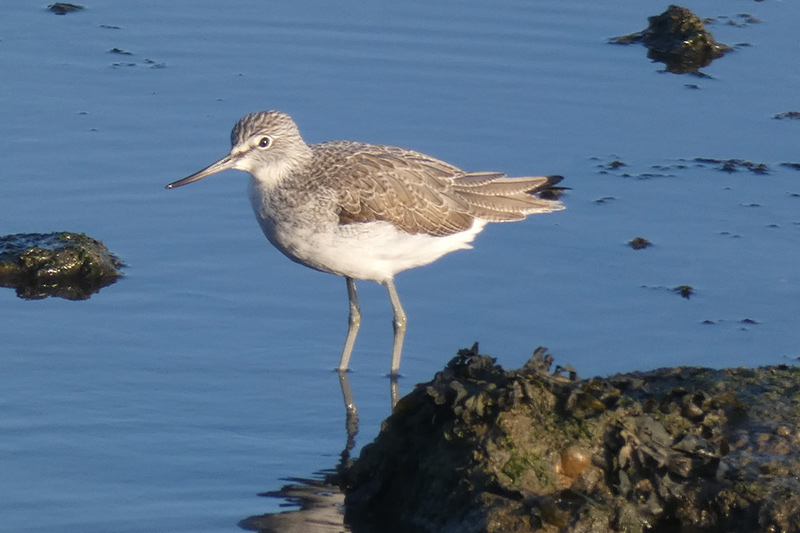
Greenshank
Compared to the Redshank, the Greenshank’s structure shows an altogether longer-legged, longer-necked, slimmer-bodied and longer-billed wader. If you can get a good view in your binoculars you will see that the greenshank’s bill is ever-so-slightly upturned. Needless to say, the legs are green (bright or dingey) and although there is a strong contrast between its darker upperparts and paler underparts – it can still look all pale, if not white, when seen from a distance. In level flight its long legs protrude beyond its tail and although it doesn’t have a white ‘trailing edge’ like its cousin the Redshank. A large white ‘V’ extends all the way up it’s back. It’s a hyperactive feeder and can be seen chasing shrimp with its head under the surface! It is not at all common in the UK but sometimes seen on passage returning to the same locations in the Autumn.
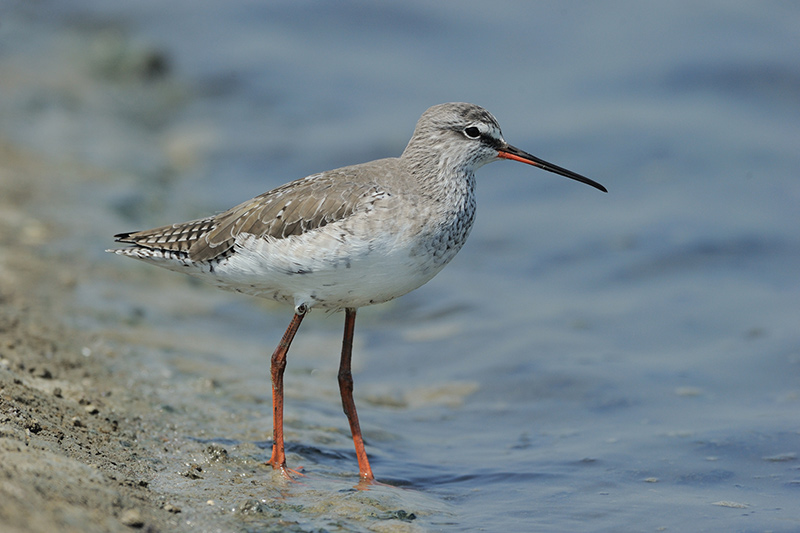
Spotted Redshank
Up next…the Spotted redshank. This is slightly larger than the Redshank and stouter than the Greenshank with the longest legs of our 3 shanks (red-orange). Its bill length is twice as long as it’s head (remember we said that this comparison is useful), more needle-ish in shape, a slight down tip at the end and an all-black upper mandible (like a kingfisher). Base of the lower mandible is orange.
How to remember which species has the longer bill? Use the birds name…Redshank …a shorter name – a shorter bill. Spotted redshank… a longer name – a longer bill!
Many bird species have ‘eyebrow’ stripes (Supercilium) which can be used as an all-year-round identifier – and the Spotted Redshank has this feature; a pale stripe above the eye. This bird also has a darker stripe extending forwards from its eye towards the bill giving it’s face a general striped appearance. In flight, it shows a white wedgy-oval on its back – but no trailing edge wing bar like the Redshank’s – and its long legs extend out past the tail in level flight – much like the Greenshank. Spotted Redshanks will feed in deeper water (longer legs) and will upend like ducks do to reach food on the muddy bottom. It isn’t common here but can be seen in the UK on passage in the Autumn and a few occasionally overwinter here. It has the most stunning breeding plumage, but this is hardly ever seen here…look out for this rare sight in July though.
Just an additional point regarding posture and stance. Shanks hunkered down – or feeding – or on high alert for predators can look very different from the pictures in bird books so take your time to notice features.
Take a look at the BTO video guide below which will reiterate the differences between these 3 shanks. Remember, the Redshank is the most common so try to get familiar with that one first.
https://www.bto.org/develop-your-skills/bird-identification/videos/bto-bird-id-common-shanks
Curlew Vs Whimbrel
Finally, onto our 3rd reference species. From the ‘large’ category…we give you…the enigmatic Curlew. This is also a ‘once seen, never forgotten’ bird although you may hear it long before you see it, so distinctive is it’s call.
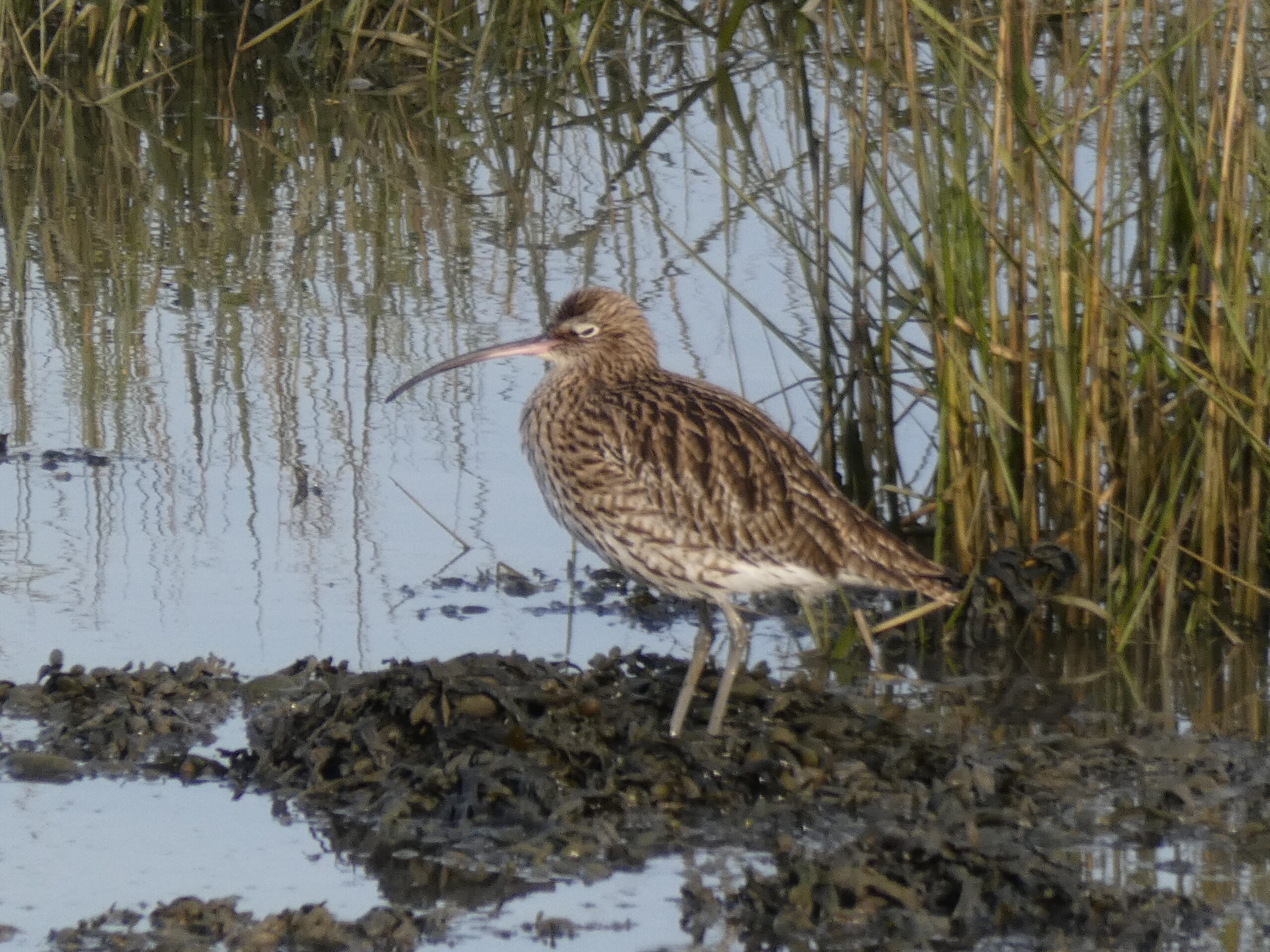
Curlew
The European Curlew, as its rightly named, is our largest wader and with an unforgettable decurved bill. This is about 15 cm’s long, pliable and with a pale pink base to the lower mandible. The females, like may long-billed waders, have a slightly longer bill allowing them to feed close to the males and not compete for the same morsel (long bill = deeper probing). In terms of plumage there is little variation between upper and underparts and so they appear a fairly uniform streaky-brown from a distance but actually have a mottled appearance brought about by dark-centred feathers with pale edges. When the tide is high and the mud covered, look out for these birds probing for Earthworms in the soft earth of coastal fields.
If you get familiar with the Curlew you are more likely to be able to pick out the much rarer Whimbrel if it’s about. The Whimbrel has some unique identifying features though if you do get that lucky. Its bill is a bit shorter and although still decurved, has a more rapid angle drop closer to the end. Remember we said earlier that face and head stripes can be useful identifiers for some species? Whimbrel is one of these. It has a dark crown with a central pale stripe, a dark stripe through the eye with a pale check and supercilium – giving the head a ‘humbug’ boiled sweet appearance which can even be seen in flight. If the Curlew calls is its name (an eerie ‘curlew, curlew’) then the Whimbrel’s call is a rapid machine-gun fire of 7 or more rapid ‘bips’.
Take a look at this BTO guide to these two beautiful birds https://www.bto.org/develop-your-skills/bird-identification/videos/bto-bird-id-curlew-and-whimbrel
Black-tailed godwit Vs Bar-tailed godwit
I was once told that for every large flock of Black-tailed godwits there will be about 15 Bar-tailed godwits amongst them, so it’s worth knowing the main differences so you can look out for them. It’s quite exciting when you spot one!. Both will be at peak numbers here between late summer and early autumn.
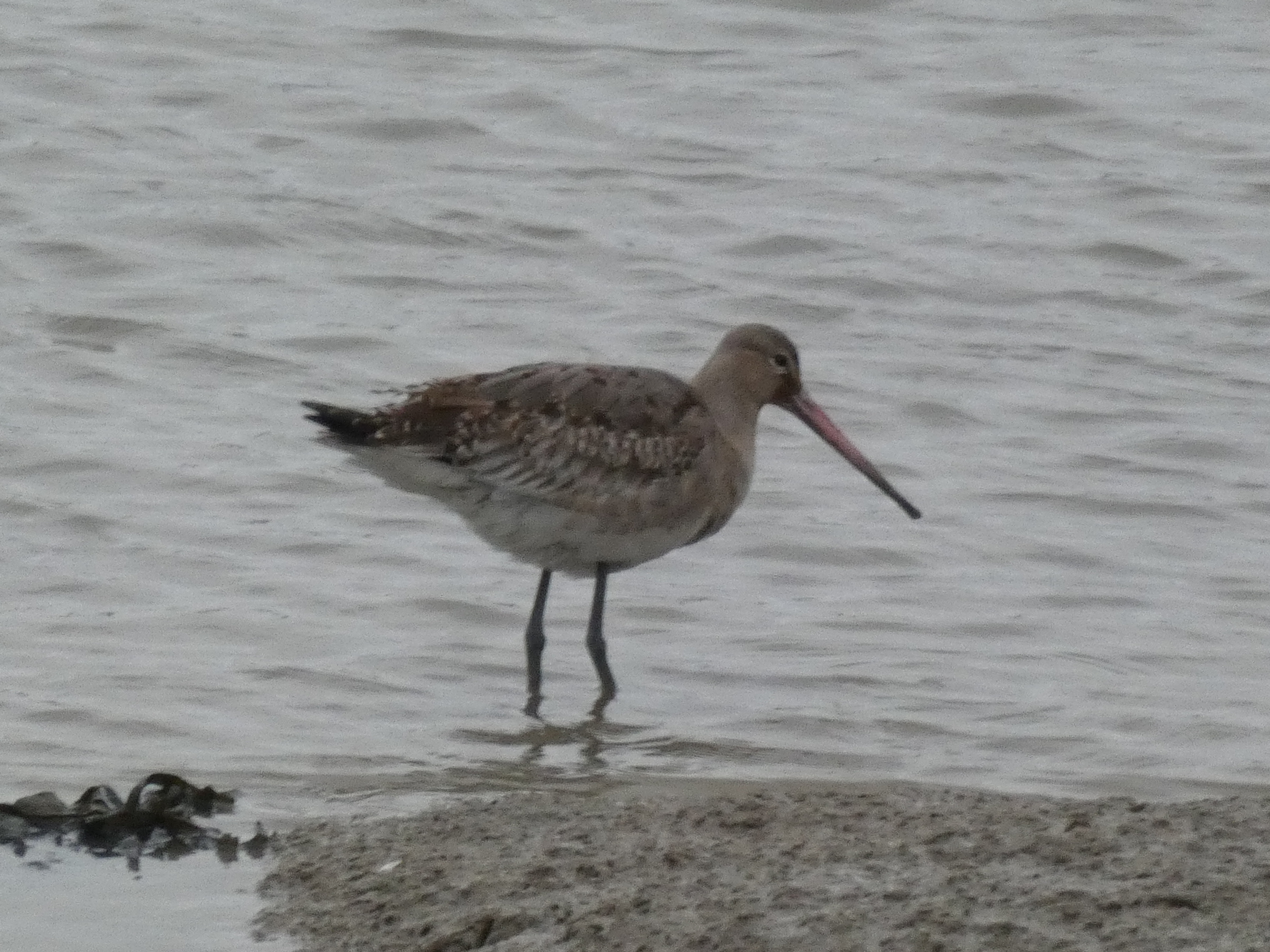
Black Tailed Godwit
Like all good birders, we will firstly try to identify the structural differences, not least because the named tail feathers (black and barred) are not easy to see on a grounded bird – and the structural differences will always be there even when both species have moulted into their strong breeding plumages.
Comparing the more common with the less common; the Black-tailed godwit appears as a slightly taller bird since it is longer-legged overall, with more ‘leg’ above the knee (which is actually the ankle but don’t worry about that now!), the bill is long and very straight, the neck is longer and in level flight its long legs extend past the tail feathers. In winter non-breeding plumage, it is a plain grey and in flight sports a broad white wing bar along the middle of the wing.
The Bar-tailed is smaller, slighter, the neck is shorter, and the bill has a distinct upturn. It can look like a little Curlew especially if it’s bill is tucked behind into its wings and invisible to us. In flight it has plain wings with no white wing bar but has a white ‘V’ shaped wedge up its back…much like the Curlew and Whimbrel (which we forgot to mention!)
The Bar-tailed winter plumage is a bit fancier, and this is something that can make them stand out in a crowd of Black-tails. It’s more scalloped or streaked – again like a Curlew – with an obvious stripe/supercilium extending backwards beyond the eye.
To summarise in flight features;
Black-tailed – bold white wing bar, white rump and black tail band
Bar-tailed – no white wing bar, white wedge on its back, barred tail
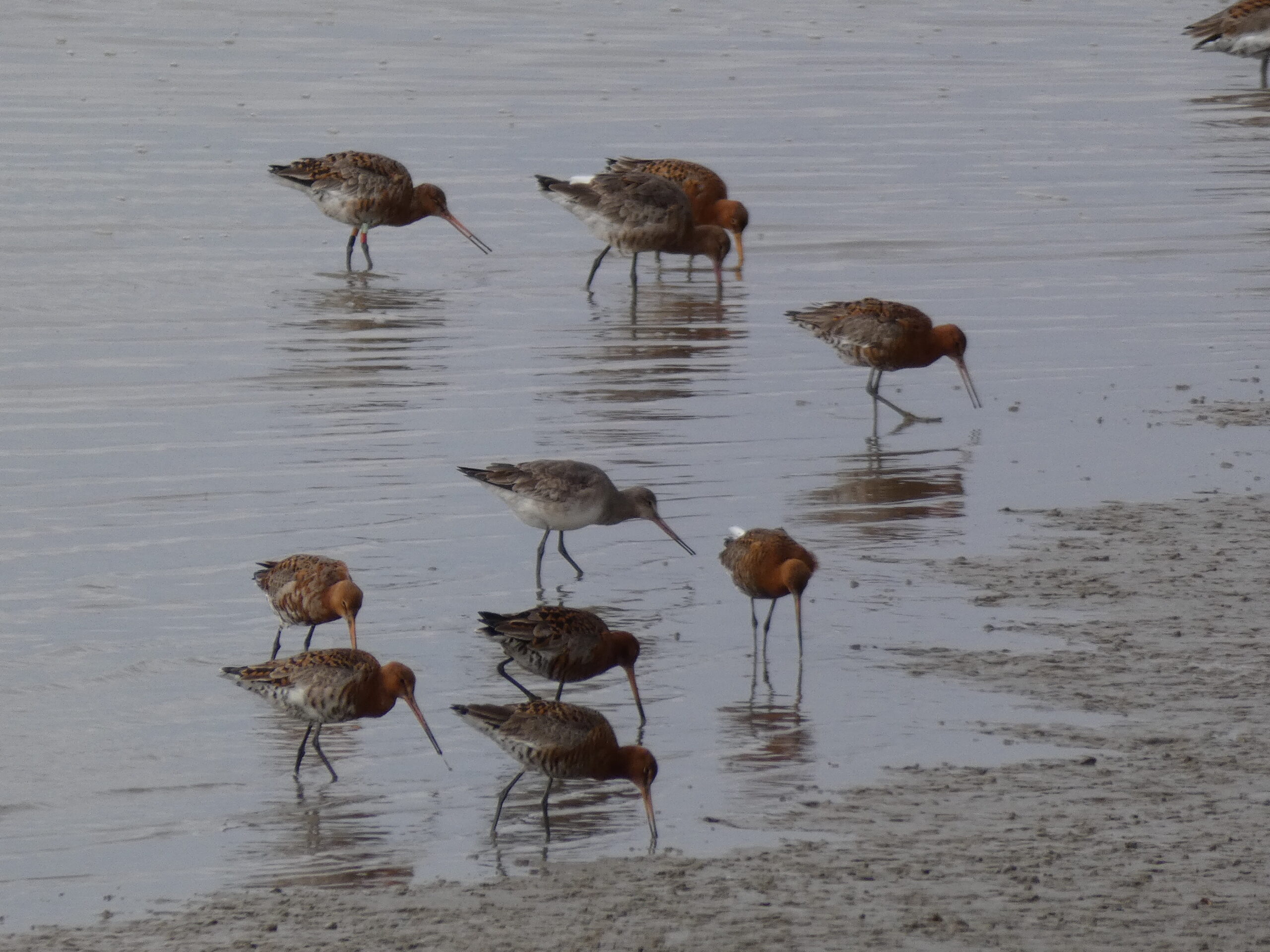 In late Spring or Autumn, you may be able to spot some of either species in their breeding plumage where the neck and chest turn a beautiful brick red. The Black-tailed will show some barring on its sides/flanks but the reddy colour won’t extend under its tail. Conversely the Bar-tailed lacks the side barring but the red does extend under its tail.
This BTO video shows all the differences between the two species
We haven’t yet touched fully on Plovers, Sanderlings and Little Stints. We could write more about Lapwings, Turnstones and Snipes but hopefully you will feel more equipped and confident now to do your own bit of investigative ID-ing with the help of our MEET THE BIRDS section on our website.
Don’t forget our TOP TIPS
- Look at the structural aspects first as these won’t change with breeding plumage
- Draw yourself a sketch of the features you see
- If you know your reference species you will know when something is not one of them…
- Lock on to birds in flight with your binoculars to see if you can see flight features – like legs protruding or wing bars
- Wing bars can be the most obvious way to separate species
- Keep looking at your reference species and build up your familiarity with the species that you know If you know them well, you will know when something is not one of them…if that makes sense!
- Check out the BTO ID guides we have listed, and you will see videos for all sorts of birds.
Happy birding and stay safe